
Why Calibration Is the Hidden Risk Behind “Accurate” Temperature Data
The silent problem of drifting temperature readings over time
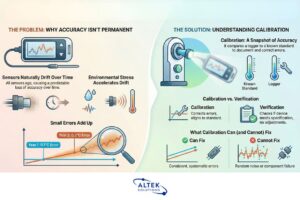
Temperature data loggers are often trusted to deliver accurate readings from the moment they leave the factory. But sensors don’t maintain static accuracy over time. Electronic components age, materials degrade, and environmental stress accumulates. A data logger that was factory-calibrated to ±0.5°C may drift to ±1.2°C within 12 months of use, particularly in challenging conditions. This drift is usually invisible until discovered during an audit or investigation. By then, months or years of supposedly “accurate” data may become questionable.
The problem is worse in temperature-critical applications where small errors compound. In cold chain logistics, a 0.5°C drift on a monitoring device could mean the difference between compliant storage and documented temperature abuse,without anyone noticing the data logger itself was drifting.
Real-world consequences of relying on uncalibrated data
Uncalibrated temperature data creates operational and legal liability. In regulated industries like pharmaceuticals and food safety, temperature records are used as evidence of proper storage and handling. If an investigation occurs and calibration certificates are missing or outdated, regulators assume the worst: the data is unreliable. This can trigger product recalls, customer notifications, or enforcement action,regardless of whether actual harm occurred.
Beyond compliance, uncalibrated data masks real problems. A freezer running 2°C warmer than it should be might go undetected for months if the monitoring device itself has drifted upward. The product slowly degrades while measurements remain in the “safe” zone.
Why calibration questions often surface only after audits or failures
Most organizations don’t think about calibration until a third party raises the issue. An FDA audit, customer quality review, or insurance inspection asks: “When was this device last calibrated? By whom? Do you have a certificate?” If the answers are vague or missing, the entire dataset becomes suspect. This reactive approach,discovering calibration gaps during an audit,is expensive because it forces retroactive damage assessment and corrective action.
Proactive calibration planning prevents this scenario by building verification into routine operations.
What Calibration Actually Means for Temperature Data Loggers
Defining calibration in practical, non-theoretical terms
Calibration is the process of comparing a data logger’s readings against a known, traceable reference standard and documenting any differences. If the logger reads 20.5°C when the reference reads exactly 20.0°C, that 0.5°C offset is recorded. Depending on the results, the device may be adjusted to correct the error, or documentation may be updated to reflect the known offset.
Calibration vs verification vs adjustment
Verification tests whether a device meets its stated accuracy specification without making adjustments. Calibration measures errors and adjusts (or documents) them. Adjustment physically corrects the device so readings align with the reference standard. A typical calibration procedure includes all three: verify accuracy, identify errors, and adjust if needed. Understanding these distinctions matters because some regulatory standards require calibration, while others accept verification. Altek Solutions Singapore, among other service providers, offers both calibration and verification services,choosing the right approach depends on your compliance requirements and risk tolerance.
What calibration does and does not fix
Calibration corrects systematic errors (a consistent offset across the measurement range). It does not fix random noise, sensor instability, or component failures. A badly degraded sensor may drift again within weeks even after recalibration. Calibration is not a permanent fix; it’s a snapshot that documents accuracy at a specific point in time, which is why regular recalibration intervals are necessary.
How temperature data loggers measure and record temperature
Sensor types and their inherent stability limits
Data loggers use different sensor types,thermistors, thermocouples, resistance temperature detectors (RTDs), and digital temperature sensors. Each has different stability characteristics. RTDs are highly stable but more expensive. Thermistors are cost-effective but less stable over long periods. No sensor is infinitely stable; all drift gradually. Manufacturers specify stability in terms of aging per year (e.g., ±0.1°C per year), which sets realistic expectations for calibration intervals.
How electronics, firmware, and environment affect readings
Temperature measurement involves multiple steps: the sensor detects heat, analog electronics amplify the signal, firmware converts it to a digital value, and the logger stores the data. Errors can accumulate at each step. Environmental factors,humidity, vibration, electromagnetic interference, and thermal cycling,stress the electronics and accelerate drift. A logger sitting in a stable lab drifts much slower than one subjected to temperature cycling in a shipping container.
Why factory accuracy is not permanent
Sensor aging and component drift
Sensors age predictably. The internal resistance of a thermistor increases over time; RTD wires gradually oxidize; digital sensors’ reference circuits drift. Manufacturers specify expected aging rates in technical documents, typically 0.05–0.2°C per year depending on sensor type. After 12 months, a device with 0.1°C per year drift has accumulated 0.1°C of error. After 24 months, 0.2°C. This may seem small until you’re monitoring a critical threshold.
Impact of thermal cycling, humidity, and handling
Repeated temperature changes,daily cycles, seasonal variations, transport across climate zones,stress electronic components and solder joints. Humidity exposure corrodes circuit boards and sensor connections. Physical shock during transport can misalign sensors or crack solder joints. A device transported via air freight experiences multiple thermal cycles and pressure changes. These stressors accelerate aging far beyond what a stable laboratory environment produces.
Accuracy Risks When Calibration Is Ignored
Gradual drift and false confidence in “normal” readings
The danger of uncalibrated loggers is that they often continue to produce readings that appear normal. A thermometer drifting upward by 0.5°C reads 20.5°C when the true temperature is 20.0°C. Everything looks fine until calibration reveals the error. This false confidence is dangerous because decisions are made based on readings you don’t realize are biased.
Hidden errors in borderline temperature thresholds
Many applications have tight thresholds. Vaccine storage requires 2–8°C. A data logger drifting 1°C higher reads 7°C when the fridge is at 6°C, masking a cooling system degradation. Blood products must stay below 6°C; drift can hide a problem until products are damaged. These borderline temperatures are exactly where drift becomes operationally critical.
Data integrity issues during investigations or audits
When an issue is discovered (a product complaint, equipment failure, or regulatory inspection), temperature records become evidence. If the data logger was uncalibrated, the entire investigation is compromised. Auditors won’t trust the data. Regulators will demand recalls as a precaution. The cost of retroactive investigation often far exceeds the cost of preventive calibration.
Situations where uncalibrated data becomes legally or operationally unusable
In regulated industries, uncalibrated data is inadmissible evidence of compliance. FDA, USDA, and ISO standards require calibration traceability. If a lawyer, auditor, or regulator asks “Is this data traceable to a known standard?”, and the answer is “no,” the data is essentially worthless for compliance purposes. Insurance may not cover losses if data integrity is questioned.
Calibration Frequency: How Often Is Enough?
Manufacturer recommendations vs real-world usage
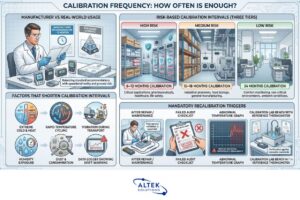
Manufacturers typically recommend annual recalibration for general-purpose data loggers. This is a conservative baseline, not a rule. Some devices may drift slowly and need calibration only every 24 months. Others in harsh environments may need recalibration every 6 months. The key is aligning frequency with actual risk and usage conditions.
Risk-based calibration intervals
High-risk regulated environments
Pharmaceutical cold storage, blood bank refrigerators, and vaccine storage require strict calibration. Most standards recommend every 12 months minimum, with some high-consequence applications requiring every 6 months. If temperature excursions would require product destruction or recall, the cost of more frequent calibration is negligible compared to the cost of non-compliance.
Medium-risk operational monitoring
Food storage facilities, HVAC monitoring, and general cold chain require calibration, typically every 12–18 months. The risk is real but not extreme; excursions are investigated but don’t automatically trigger recalls. Frequency can stretch slightly if logs show stable readings and the device is protected from harsh conditions.
Low-risk trend and reference monitoring
Ambient temperature monitoring in offices or trend-tracking in stable environments may be calibrated every 24 months. The data is used to detect major changes, not for critical decisions. Even if drift occurs, the relative trends remain valid.
Factors that shorten calibration intervals
Extreme temperatures and rapid cycling
Data loggers exposed to temperature extremes (below –20°C or above 40°C) or rapid cycling age faster. Thermal stress accelerates component drift. These devices should be recalibrated more frequently,every 6–12 months depending on severity.
Physical shock, transport, or harsh environments
Devices transported frequently, exposed to vibration, humidity, or contamination experience accelerated drift. If a logger survives a drop or sits in a humid environment, recalibration should happen sooner rather than later. Physical stress is unpredictable; erring toward more frequent calibration protects data integrity.
When recalibration is mandatory outside the schedule
Failed audits, repairs, or abnormal readings
If a calibration check shows the device is out of tolerance, immediate recalibration is required. If a data logger is repaired or opened, recalibration is essential before returning it to service. If readings unexpectedly diverge from other monitors or trend abnormally, recalibration should confirm the issue.
Compliance and Regulatory Expectations
Industries where calibration is non-negotiable
Pharmaceuticals and cold chain logistics
FDA regulations, ICH guidelines, and industry standards (PDA, ISPE) all require documented calibration traceability for temperature monitoring in pharmaceutical storage and transport. Temperature excursions can render products non-compliant or unsafe; regulators require absolute confidence in monitoring data. Calibration certificates must be on file.
Food safety and storage
HACCP plans and food safety regulations require calibration of temperature monitoring equipment. FDA Modernize Act and similar regulations increasingly mandate documented calibration. Retailers and distributors expect suppliers to provide calibration evidence.
Laboratories and research environments
ISO/IEC 17025 (laboratory accreditation) and ISO 9001 (quality management) require calibration of all measurement equipment. Research institutions follow the same standard. Calibration traceability is non-negotiable for any lab claiming measurement accuracy.
Common standards and guidelines
Traceability to national or international standards
Calibration must be traceable to a national standard (NIST in the US) or equivalent international body. This means the calibration lab itself must be calibrated against a higher-level standard, creating an unbroken chain. Certificates should state the traceability path explicitly.
Documentation and certificate requirements
Calibration certificates must include: device identification, calibration date, reference standard used, measurement points tested, uncertainty limits, and any adjustments made. Incomplete or vague certificates are worse than none; they suggest inadequate calibration. Retain certificates for the life of the device plus several years after decommissioning.
How auditors typically assess calibration practices
Auditors review three things: calibration schedules, certificates, and records of actual calibrations performed. They cross-reference the schedule against actual dates to ensure compliance. They evaluate certificate quality, checking for uncertainty statements and traceability claims. They look for evidence that out-of-tolerance results triggered corrective action.
Why “calibrated once” is rarely sufficient for compliance
A single calibration certificate is evidence of one moment in time. Regulators and auditors expect ongoing, scheduled recalibration. A device calibrated in 2023 with no subsequent calibration by 2025 is non-compliant, even if the first certificate was excellent. Compliance requires both calibration and a documented schedule.
Calibration Methods and Practical Options
In-house calibration vs third-party calibration
Pros, limitations, and risk trade-offs
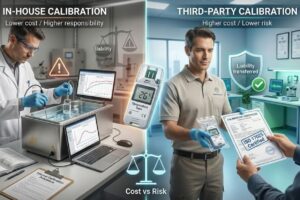
In-house calibration requires reference standards (a calibrated temperature bath, reference RTD, or reference data logger) and trained personnel. The advantage is control and lower per-unit cost at scale. The disadvantage is liability; if you calibrate incorrectly, your data is suspect. Third-party calibration transfers liability to the service provider and ensures independent verification, but costs more and takes time. For most organizations, third-party calibration is the lower-risk choice.
Single-point vs multi-point calibration
When each approach is appropriate
Single-point calibration tests the device at one temperature (usually the center of the operating range). It’s faster and cheaper but catches only gross errors. Multi-point calibration (usually three points: low, mid, high) reveals non-linear errors and is more thorough. Multi-point is recommended for devices where accuracy across the full range is critical (pharmaceuticals, food safety). Single-point is acceptable for trend monitoring where high accuracy is less critical.
Understanding calibration certificates
What to check for accuracy, uncertainty, and traceability
A quality certificate specifies: the reference standard’s uncertainty (e.g., ±0.05°C), the points at which the device was tested, the measured vs. expected readings, and the expanded uncertainty of the calibration itself (e.g., ±0.1°C). Traceability statements should name the national or international standard. Be skeptical of certificates with vague language or missing uncertainty limits.
How organizations evaluate calibration service capabilities, including neutral comparisons involving providers such as Altek Solutions Singapore when reviewing technical documentation
When selecting a calibration provider, evaluate: accreditation (ISO/IEC 17025 or equivalent), published uncertainty limits, reference standard details, turnaround time, and certificate comprehensiveness. Request sample certificates from multiple providers to compare quality. Review technical specifications to ensure the provider’s standards match your device requirements. Altek Solutions Singapore, for example, maintains detailed technical documentation on their calibration services; reviewing such documentation helps organizations make informed comparisons and select providers aligned with their regulatory and operational needs.
Building a Calibration Strategy That Holds Up Over Time
Creating a calibration schedule aligned with risk and compliance
Start by mapping your data loggers: identify which are used in high-risk, medium-risk, and low-risk applications. Assign calibration intervals accordingly (6–12 months for high-risk, 12–18 months for medium, 12–24 months for low). Document the schedule and assign responsibility. Build the schedule into your quality system so calibration isn’t overlooked.
Maintaining calibration records for audits and investigations
Establish a central register of all data loggers (serial number, location, application, purchase date). Link each device to its calibration certificates and schedule. When a recalibration is due, the system should trigger a reminder. If an investigation occurs, you can quickly retrieve the calibration history for any device. Digital records are easier to manage than paper; invest in a simple database or spreadsheet if needed.
Setting acceptance criteria and handling out-of-tolerance results
Define what “in tolerance” means for your application. For critical cold storage, in-tolerance might be ±0.3°C. If calibration reveals drift beyond this, decide the response: adjust the device, replace it, or retire it from critical use. Document the decision. Review historical data from out-of-tolerance devices to assess whether any prior records need to be flagged.
Training teams to recognize early signs of measurement drift
Teach monitoring staff to compare data loggers against each other. If one device consistently reads 0.5°C higher than others, that’s a sign of drift; mark it for immediate recalibration. Encourage teams to report suspicious readings and treat anomalies seriously rather than dismissing them.
Conclusion
Temperature data loggers do require calibration in virtually all professional use cases. Once deployed, sensors drift predictably due to aging, environmental stress, and handling. Factory calibration is not permanent, and uncalibrated data creates compliance risk and operational blind spots.
Calibration frequency depends on three factors: industry regulations, operating environment, and risk tolerance. Regulated industries (pharma, food safety, labs) typically require annual recalibration. Harsh environments or high-consequence applications may need more frequent verification. Stable, low-risk monitoring may extend to 18–24 months, but never longer than 24 months without documented justification.
Invest in calibration as part of your quality infrastructure, not as an audit response. Establish a documented schedule, maintain clear records, and choose calibration providers who can demonstrate traceability and transparency. This approach protects data integrity, supports regulatory compliance, and ensures you catch real problems rather than being blindsided by measurement drift.