
Understanding What Each System Is and What It Is Not

How a USB data logger works, from sensor to download to report
A USB data logger is a standalone device that records temperature at defined intervals and stores that data internally. Retrieving the data requires physically connecting the device to a computer, typically via USB, then using software to extract, view, and export the records. No network, no cloud account, and no IT infrastructure are needed for the device to function.
The gap no one discusses at purchase
Between manual downloads, which may happen weekly, bi-weekly, or monthly, there is zero visibility into what is happening in storage. A temperature excursion that occurs, peaks, and recovers within that window will appear in the data only after retrieval. By then, affected products may already have been distributed.
Where USB loggers genuinely perform well, and where they fall short
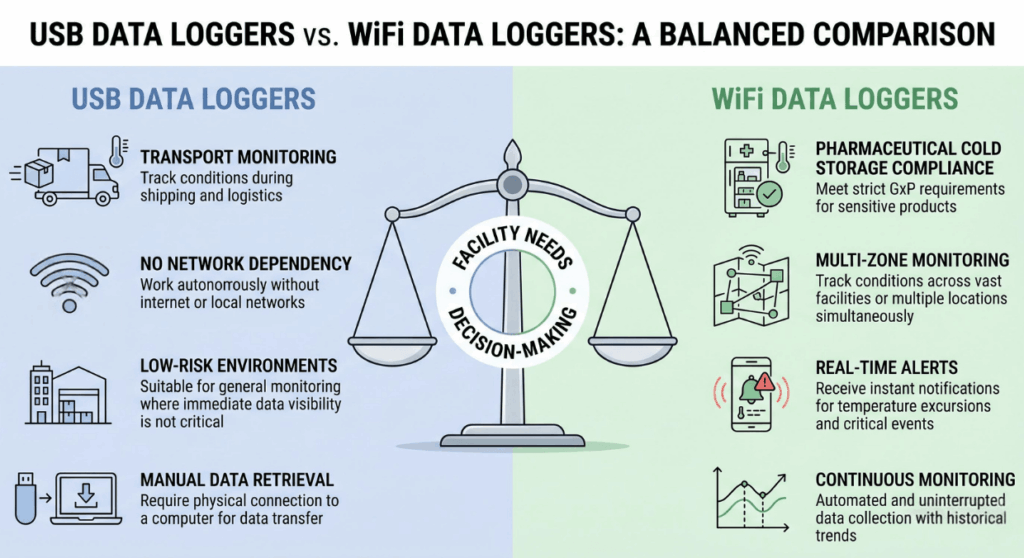
USB loggers are reliable, low-maintenance, and well-suited for transport monitoring, short-duration deployments, and low-risk ambient applications. They fall short wherever continuous visibility, real-time alerting, or multi-point simultaneous monitoring is required, operationally or under regulatory obligation.
How a WiFi data logger works, continuous transmission, cloud storage, and real-time alerts
A Wi-Fi data logger transmits temperature readings over a wireless network at the defined logging interval, continuously, automatically, and without manual retrieval. Data lands in cloud-based or server-based software, accessible from any authorised device. More importantly, deviations trigger alerts in real time, allowing immediate response before an excursion compounds.
What “real-time monitoring” actually means in practice
Real-time in this context means alerts generated at the logging interval, typically every 5, 10, or 15 minutes. It does not mean instantaneous, second-by-second notification. If your logger samples every 15 minutes, your alert arrives within 15 minutes of the excursion. That distinction matters when setting thresholds for high-sensitivity products.
The infrastructure requirements for WiFi monitoring depend on
WiFi loggers need stable wireless network coverage at every monitoring point, reliable power, and a functional cloud or server platform. In facilities with signal dead zones, common in large warehouses, cold rooms with thick insulation, or basement storage, WiFi deployment may require network infrastructure upgrades before a single logger goes live.
Where the terminology gets confusing, Bluetooth, WiFi, and cloud-connected are not the same.
Bluetooth loggers transmit to a nearby mobile device, not to a network. Someone must be physically present with a phone or tablet to retrieve data. WiFi loggers transmit directly to your network infrastructure. Cloud-connected systems may use either WiFi or cellular connectivity. When evaluating any system, confirm the actual transmission method. “Wireless” does not always mean continuously monitored.
Side-by-Side Comparison – The Factors That Actually Drive the Decision
The table below cuts through the surface-level differences and maps the criteria that actually determine which system is operationally appropriate for your facility.
| Factor | USB Data Logger | WiFi Data Logger |
| Real-time alerts | No | Yes |
| Network infrastructure required | No | Yes |
| Manual data retrieval | Yes (physical download) | No (automatic) |
| Compliance for continuous GMP monitoring | Limited | Well-suited |
| Battery life | Weeks to months | Shorter (active transmission) |
| Multi-zone simultaneous visibility | No | Yes |
| Upfront cost | Lower | Higher |
| IT dependency | Minimal | Moderate to high |
| Best for | Transport, short-term, low-risk | Regulated storage, multi-zone, real-time response |
Why starting with price leads facilities to the wrong choice
The total cost of a USB logger system includes staff time for retrieval, manual report compilation, and the operational consequences of delayed excursion detection. These costs are invisible at purchase and significant in practice.
The compliance dimension- what HSA GDP guidelines, SFA, and GMP requirements say
The HSA Guidance Notes on Good Distribution Practice require pharmaceutical importers and wholesalers to maintain continuous temperature monitoring with documented records demonstrating products were stored within validated conditions at all times. SFA’s licensing conditions for coldstores and food processing establishments similarly require ongoing temperature monitoring with documented calibration of all monitoring devices. The WHO Technical Supplement on Temperature Mapping recommends recording intervals of 1–15 minutes for pharmaceutical storage environments. USB systems can technically meet recording interval requirements. What they cannot provide is the real-time deviation response that continuous monitoring is designed to enable.
Which System Fits Which Facility: A Practical Decision Framework
When a USB data logger is the operationally correct choice
- Short-duration transport monitoring and cold chain shipments – For pharmaceutical shipments, food deliveries, and sample transport where the requirement is to verify conditions were maintained during transit, a USB logger provides a complete, tamper-evident record at low cost with no infrastructure dependency.
- Facilities where network coverage cannot be reliably guaranteed – Not every facility can support stable WiFi coverage across all monitoring points. Deploying a WiFi system into an infrastructure-limited environment produces data gaps, the opposite of what continuous monitoring is meant to achieve.
- Low-risk ambient monitoring with infrequent review cycles – Office environments, general storage areas, and non-critical applications where temperature drift is a quality indicator rather than a safety or compliance trigger are well-served by USB loggers.
When WiFi monitoring becomes the operationally necessary choice

Pharmaceutical cold storage requiring continuous GMP-compliant records
Any storage environment where records must demonstrate continuous, uninterrupted compliance and where excursion response time directly affects product integrity requires real-time monitoring capability. The HSA GDP Standards page confirms GDP compliance is mandatory for all local pharmaceutical importers and wholesalers, with audits conducted before licence issuance.
Multi-zone warehouse monitoring where manual retrieval is impractical at scale
A warehouse with 15 temperature zones managed by a two-person team cannot realistically retrieve, compile, and review USB logger data across all zones at meaningful intervals. WiFi monitoring resolves this operationally.
Facilities where preventing excursions matters more than documenting them
The clearest argument for WiFi monitoring in regulated environments comes down to one distinction: USB loggers tell you what happened. WiFi loggers allow you to intervene before the outcome is irreversible.
Hybrid approaches: when one system is not enough
Altek Solutions, a precision measurement instruments supplier based in Singapore, works with facilities that run USB loggers for transport legs and WiFi loggers for fixed storage zones. That configuration matches monitoring technology to the actual risk profile of each application, rather than applying one system uniformly across environments with different requirements.
Common Decision Mistakes and How to Avoid Them
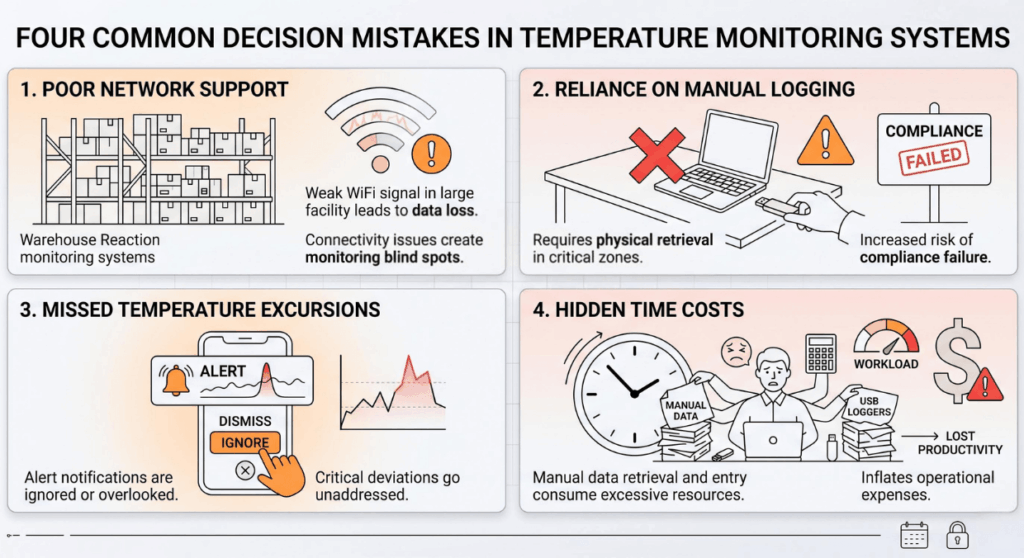
Buying WiFi loggers for an environment where the network cannot support them
Confirm network coverage before ordering equipment. A signal survey is not optional; it is part of the commissioning process.
Choosing USB loggers for a regulated application where continuous records are expected
When your compliance obligation specifies continuous monitoring, a USB system with periodic manual retrieval does not satisfy that requirement, regardless of the logging interval setting.
Treating alert capability as a convenience feature in temperature-critical storage
Alerts are a product integrity control. An undetected excursion running overnight in pharmaceutical cold storage affects every product in the zone. That is not a minor operational gap.
Underestimating the time cost of manual USB data retrieval at scale
At one hour per retrieval cycle across 10 monitoring points, a weekly programme consumes 520 staff hours annually. That is a real operational cost that almost never appears in the purchase evaluation.