
What Is HACCP?

Where HACCP Came From and Why It Became the Global Standard
HACCP was developed in the 1960s by the Pillsbury Company and NASA to ensure safe food for astronauts. Its core logic, preventing hazards before they cause harm rather than detecting damage after the fact, was adopted by the Codex Alimentarius Commission as the international food safety management standard. Singapore’s SFA and HSA both reference Codex Alimentarius principles in their licensing and GDP requirements.
The Seven Principles of HACCP Explained
The table below maps each principle to its cold chain application. Understanding how they connect is the clearest way to identify where a cold chain operation has gaps.
Principle | What It Requires | Cold Chain Application |
1: Hazard Analysis | Identify all biological, chemical, and physical hazards at each stage | Identify pathogen growth risk at storage, transport, loading, and handoff stages |
2: Critical Control Points | Determine which stages control or eliminate hazards | Cold rooms, refrigerated vehicles, and loading docks are typically all CCPs |
3: Critical Limits | Set measurable boundaries at each CCP | Chilled products below 4°C, frozen below minus 18°C, pharma products 2°C to 8°C |
4: Monitoring Procedures | Define how, how often, and by whom each CCP is measured | Continuous automated data logging with timestamped records |
5: Corrective Actions | Document what happens when a CCP exceeds its limit | Written procedure: who is notified, what is done with the product, how recurrence is prevented |
6: Verification | Confirm the plan works as intended | Calibration of monitoring instruments, temperature mapping, and internal audits |
7: Record-Keeping | Maintain documentation that demonstrates compliance over time | Monitoring logs, alarm records, corrective action reports, and calibration certificates |
With the seven principles understood in cold chain terms, it is worth clarifying where HACCP sits relative to the broader ISO 22000 framework that some Singapore businesses also encounter.
HACCP vs ISO 22000: What Is the Difference and Which Applies in Singapore?
ISO 22000 incorporates HACCP within a broader food safety management system that also covers communication, resource management, and continuous improvement. HACCP compliance satisfies SFA licensing requirements for most food businesses in Singapore. ISO 22000 certification carries additional value for companies supplying hotels, hospitals, or international trade partners where third-party certification is a procurement condition.
Why Temperature Control Is Almost Always a Critical Control Point
What Biological Hazards Temperature Control Is Actually Preventing
Bacterial pathogens, including Salmonella, Listeria monocytogenes, and E. coli, multiply rapidly when food products are stored or transported outside safe temperature ranges. The WHO estimates that unsafe food causes 600 million illnesses globally each year, with temperature abuse among the most preventable contributing factors. In pharmaceutical cold chains, temperature excursions degrade active ingredients rather than introduce pathogens, but the compliance consequence is identical.
How Temperature Becomes a CCP at Each Stage of the Cold Chain
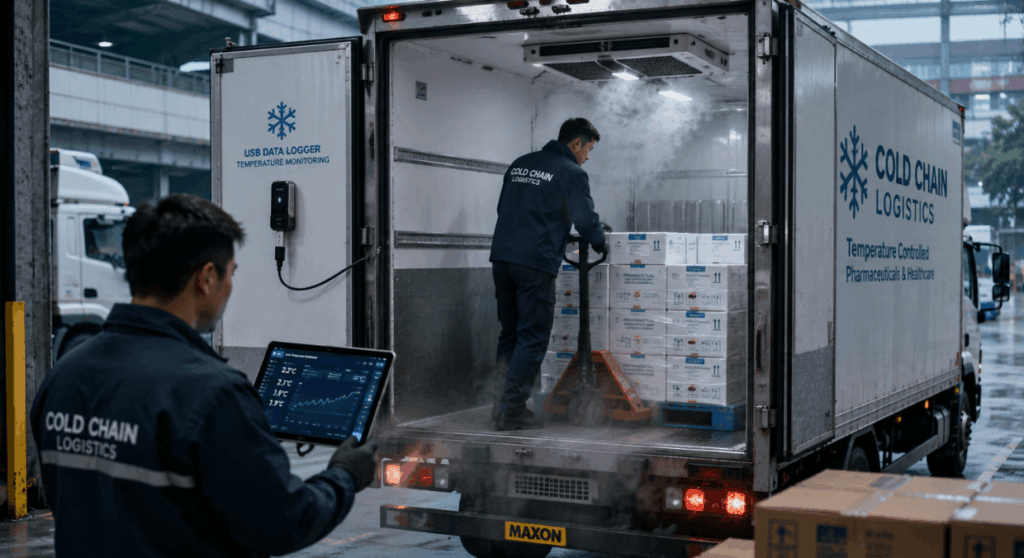
Temperature control is a CCP at every point where a hazard can be introduced or worsened. In a cold chain, this includes cold room storage, refrigerated transport, the receiving bay at delivery, and any staging area between cold environments. The loading and unloading stage is frequently identified as a CCP in well-developed plans and overlooked entirely in underdeveloped ones.
Setting the Critical Limit: What Singapore Regulations and Product Specifications Require
SFA requires chilled food products to be maintained at or below 4°C and frozen products at or below 18 °C. HSA GDP guidelines require most pharmaceutical products to be maintained between 2°C and 8°C with documented deviations managed under a formal excursion protocol. Where product specifications are stricter than regulatory minimums, the product specification takes precedence in the HACCP plan.
How HACCP Applies to Cold Chain Operations in Singapore

Mapping the Cold Chain to the Seven HACCP Principles: A Practical Walkthrough
Cold Room Storage as a CCP: What Compliance Looks Like in Practice
A compliant cold room requires sensors positioned at identified worst-case locations, not at convenient wall positions. It requires alarm thresholds set to reflect the critical limit, real-time notification to a named responsible person, and a corrective action procedure that activates when the threshold is crossed.
Refrigerated Transport as a CCP: The Stage Most Often Under-Monitored
In-transit temperature records are requested in almost every food and pharmaceutical HACCP audit in Singapore. A vehicle with a functioning refrigeration unit but no continuous temperature record does not satisfy Principle 4. USB data loggers placed at the time of loading produce the unbroken record that Principle 4 requires.
Loading, Unloading, and Staging: The Overlooked Critical Stage
The time a product spends outside refrigerated storage during transfer is often the most exposure-prone stage in the entire cold chain. Standard operating procedures for loading and unloading, including maximum permitted exposure times, become part of the plan when this stage is correctly identified as a CCP.
What Continuous Monitoring Satisfies That Manual Logging Structurally Cannot
A manual log that records temperature once every four hours leaves three hours and fifty-nine minutes of unverified time between entries. Automated data loggers record continuously. Electronic records with tamper-evident timestamps carry significantly greater evidential weight in a regulatory audit than handwritten entries, which are vulnerable to retroactive completion.
Corrective Action Documentation: The HACCP Principle Most Cold Chain Facilities Fail
A temperature excursion that appears in the monitoring record without a corresponding corrective action record is a major non-conformance. The corrective action record must state who was notified, what was decided about the affected product, what was done to address the root cause, and when normal conditions were restored.
Calibration as a Verification Requirement Under Principle 6
Why Uncalibrated Instruments Invalidate Your HACCP Temperature Records
Instrument drift means a sensor reading 2°C lower than its true value produces apparent compliance in the records while the actual product temperature exceeds the critical limit. If the instrument is unverified, the records it generated are unverified, and the plan built on those records has no verified basis.
What a Compliant Calibration Certificate Must Contain for HACCP Purposes
An auditor reviewing calibration certificates under Principle 6 will check for ISO/IEC 17025 accreditation of the issuing laboratory, measurement results at each test point against the reference standard, stated measurement uncertainty, and traceability to a national metrology standard. A pass/fail statement without supporting measurement data does not satisfy this requirement.
What a HACCP-Compliant Cold Chain Monitoring System Actually Looks Like
Sensor Placement: Why Location Determines Whether Your Records Are Representative
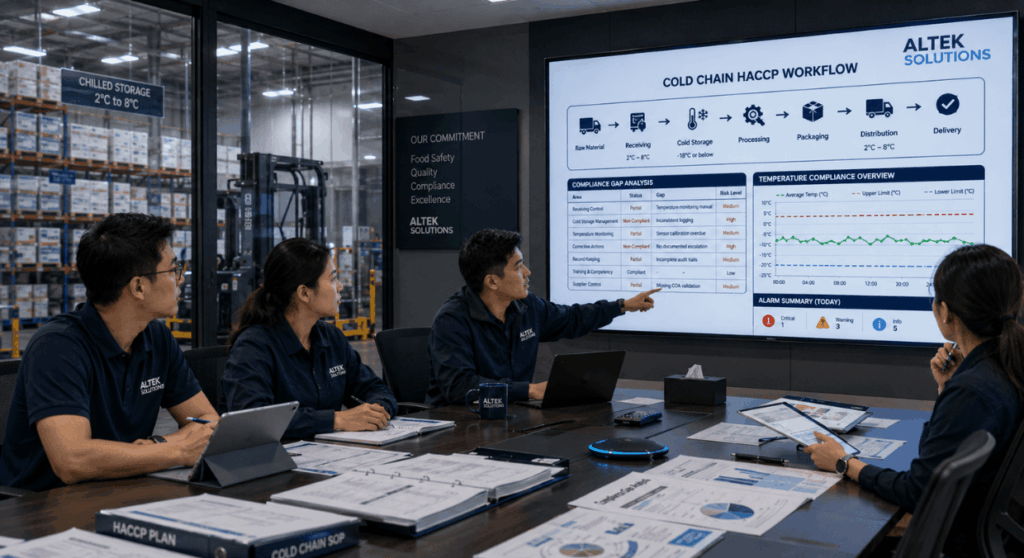
A temperature mapping study identifies hot spots and cold spots within a storage space under real operating conditions. Sensors placed at identified worst-case locations produce records that represent genuine product exposure. Sensors placed at convenient locations near doors or control panels may record conditions that are consistently better than what products in the furthest corners of the facility actually experience.
Alert Thresholds, Escalation Protocols, and Real-Time Notification
Alert thresholds should be set below the critical limit to allow corrective action before a breach becomes a product safety event. An alarm that notifies one person with no escalation fails the Principle 5 requirement if that person does not respond. A documented escalation protocol defines who is contacted if the first notification receives no response within a specified window.
Documentation That Survives an Audit
A complete cold chain record set includes continuous monitoring data, alarm event logs, corrective action records linked to specific excursions, calibration certificates for every instrument, and the temperature mapping study that determined sensor positions. Altek Solutions is one example of a Singapore supplier active in food and pharmaceutical cold chain instrumentation since 1995. Their data logging equipment generates continuous electronic records structured for regulatory audit submission.