
WHAT IS A DATA LOGGER?
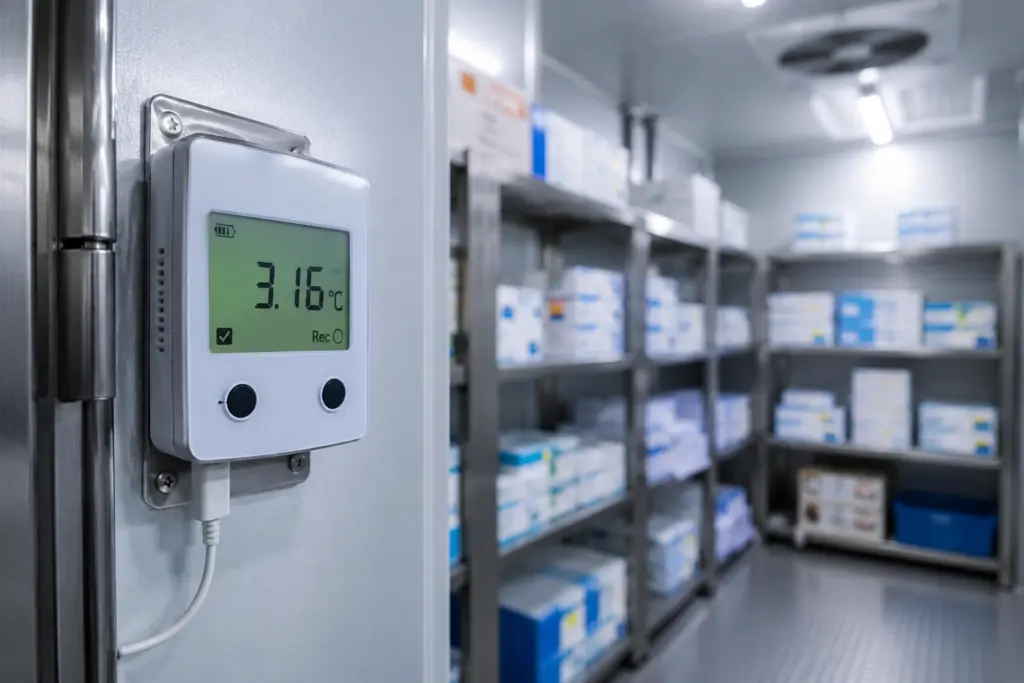
A data logger is a device that records measurements, most commonly temperature or humidity, automatically and continuously over time, storing the readings for later review or transmitting them in real time to a connected system. Unlike a standard thermometer, which gives you a single reading at the moment you check it, a data logger builds a complete, timestamped history of conditions across hours, days, or months without anyone needing to be present.
That’s the short answer. The more useful question for most buyers is which type of data logger actually fits their use case, and how it differs from the other measurement tools it’s often confused with.
How a Data Logger Differs From a Thermometer and a Thermocouple
These three terms get used interchangeably, but they describe different things, and mixing them up leads to buying the wrong tool.
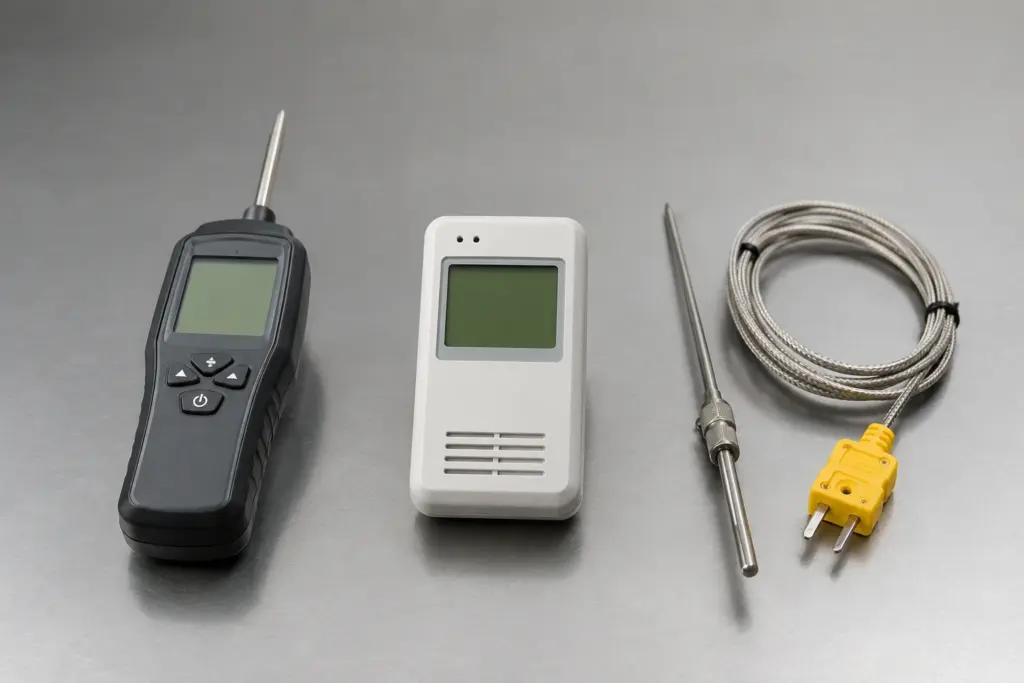
A thermometer gives you a reading at a single point in time. You check it, you get a number, and unless the specific model has built-in memory, that reading isn’t saved anywhere. This is the right tool for a spot-check, such as confirming a dish has reached safe cooking temperature during food prep.
A data logger is built for unattended, continuous recording. It measures automatically at set intervals and stores every reading, which is what makes it possible to prove, hours or days later, that a cold room stayed within range overnight or that a shipment never entered the temperature danger zone during transit.
A thermocouple isn’t a competing category at all. It’s a type of temperature sensor, a probe technology that either a thermometer or a data logger can use as its input. When you see a thermometer or logger described as accepting a “Type T” or “Type K” probe, that’s a thermocouple doing the actual sensing while the device it’s plugged into does the displaying or recording.
Device | What It Does | Records Over Time? | Example | Best For |
Digital thermometer | Instant single-point reading | No, unless it has built-in memory | Testo 108 (accepts Type T/K thermocouple probes) | Spot-checks during food prep or receiving |
Data logger | Records and stores readings automatically at set intervals | Yes | Testo 175 T1 | Unattended monitoring in cold storage, transport, or storage rooms |
Thermocouple | A sensor/probe type, not a standalone device | Depends on what it’s connected to | Used as the probe input on the Testo 175 T3 | Wide-range or high-temperature sensing inside a thermometer or logger |
The practical takeaway: if you need to prove conditions stayed within range over time, unattended, you need a data logger. If you just need to check a single reading right now, a thermometer does the job, and a thermocouple is simply the sensor inside either device, not a separate purchase decision.
Types of Data Loggers
Data loggers are generally categorised by what they measure and how they connect, rather than being one universal product.
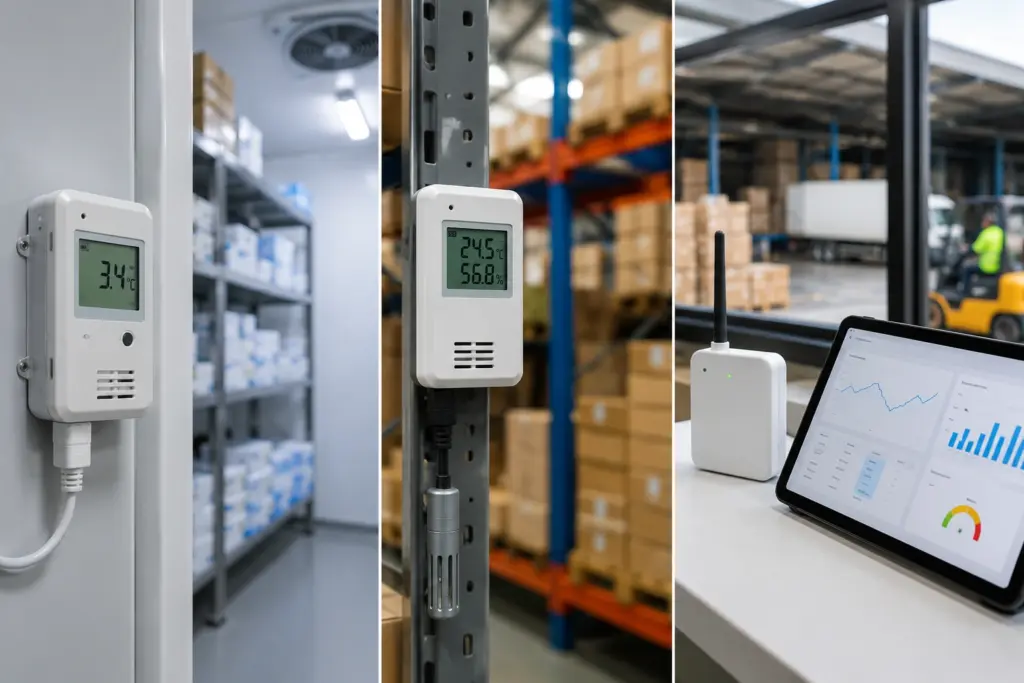
Temperature data loggers are the most common type, built for continuous single- or dual-point temperature tracking. Models range from compact single-use loggers rated for around 500 days of battery life on a single unit, up to loggers rated for three years of continuous operation with storage for up to a million readings. Some models, like a dual-channel logger with a thermocouple probe input, can measure across an unusually wide range, from around -50°C to +1,000°C depending on the probe connected, which matters for applications well beyond food and cold storage.
Humidity and temperature data loggers track both parameters simultaneously, which matters wherever moisture control affects product quality or preservation, such as archives, warehousing, or pharmaceutical storage. Some models in this category also monitor light exposure (lux) and UV radiation, which is relevant for museums, galleries, or archival storage where light damage is as much a concern as temperature or humidity.
WiFi and connected data loggers transmit readings in real time to a cloud platform rather than requiring manual download, with configurable alerts for out-of-range readings. This trades a higher upfront cost for the ability to catch a temperature excursion the moment it happens rather than discovering it after the fact during a manual data pull.
For Altek’s current range across these categories, see Temperature Data Loggers, Humidity and Temperature Data Loggers and WiFi Data Loggers.
It’s worth noting that some industrial contexts also use voltage or current data loggers for electrical monitoring. That’s a genuinely different category built around electrical measurement rather than environmental conditions, and it’s a separate buying decision from the temperature and humidity loggers covered here.
The Specs That Actually Matter
Accuracy and measuring range. Check the range against your actual application, not just the headline number. A logger built for cold storage typically covers roughly -35°C to +55°C, which comfortably spans both chilled and frozen conditions. A logger designed to accept thermocouple probes can measure a much wider range, useful for applications like heating-system flow temperatures that fall well outside standard cold-chain needs.
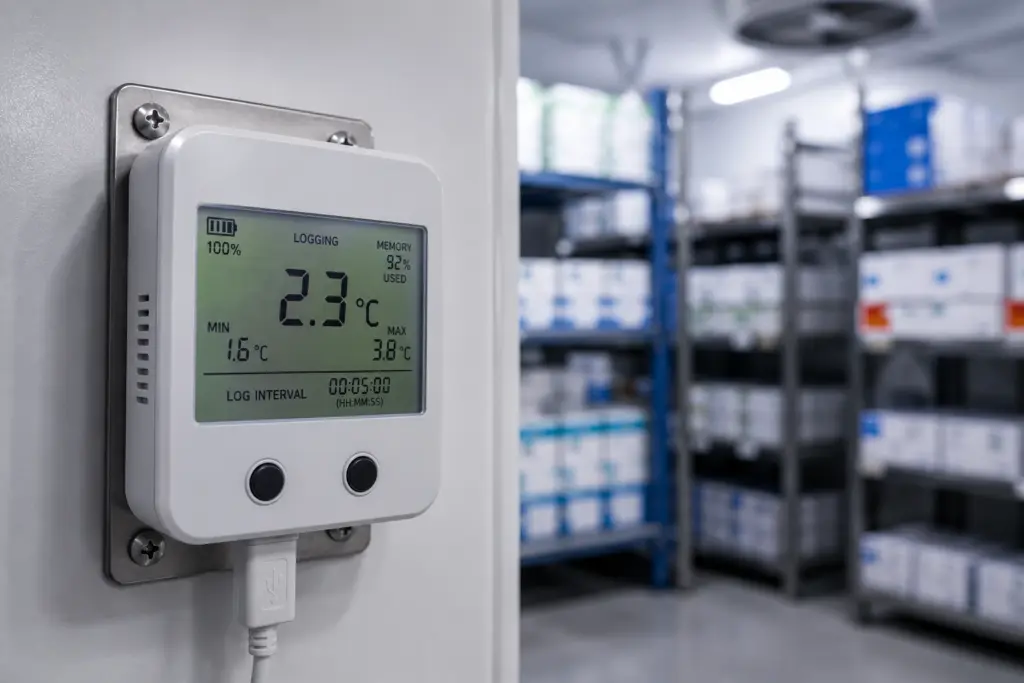
Logging interval. This is how frequently the device takes a reading, and it directly determines how quickly you’d catch a problem. A shorter interval catches a fast temperature spike sooner but fills up memory faster and drains battery quicker. For most cold-chain and storage applications, an interval in the range of a few minutes balances catching real excursions against reasonable battery and memory life.
Battery life. This varies enormously by model, from around 500 days on a compact single-purpose logger up to roughly 8 years on a display-equipped model with more advanced memory and connectivity. Longer battery life generally means less frequent maintenance, which matters more in hard-to-reach or unattended locations like the back of a delivery vehicle than in a location someone checks daily anyway.
Storage capacity. Ranges from around 16,000 readings on compact models to over a million on higher-capacity loggers. For continuous long-term monitoring without frequent manual downloads, storage capacity determines how long a logger can run unattended before data needs to be pulled or risks being overwritten.
Singapore Cold-Chain and Compliance Applications
Data logging isn’t optional documentation in many Singapore contexts; it’s a regulatory expectation. The Singapore Food Agency requires chilled food to be maintained at 0°C to 4°C and frozen food at -18°C or below during transport, with temperature-sensitive food not permitted to sit in the 5°C to 60°C danger zone for more than two hours cumulatively [SFA, Transport of Frozen and Chilled Food ]. A data logger is a practical way to demonstrate that this was actually maintained, rather than simply asserting it, since a continuous, timestamped record is what an inspection or an audit trail needs.
Many data loggers built for food applications are certified to standards such as HACCP and EN 12830, the European standard that specifically covers temperature recorders for transporting, storing, and distributing temperature-sensitive goods. That certification is a meaningful signal that a logger’s accuracy and reliability have been independently assessed for exactly this use case, rather than being a general-purpose device repurposed for food safety.
For pharmaceutical and healthcare-adjacent storage, Singapore’s Health Sciences Authority requires importers and wholesalers of therapeutic products to maintain a quality system ensuring products are stored under the conditions specified by their marketing authorisation, under its Good Distribution Practice framework. [HSA, Good Distribution Practice Standards]. Continuous temperature and humidity logging is a core part of demonstrating compliance in practice, not just a best-practice suggestion.
Humidity monitoring matters beyond pharmaceuticals too. Singapore’s tropical climate means ambient humidity is consistently high year-round, which makes humidity logging genuinely useful for archives, electronics storage, and any warehousing where moisture, not just temperature, affects product condition.
FAQ
A thermometer gives a single reading at the moment you check it. A data logger records and stores readings automatically over time, which is necessary for proving conditions stayed within range while unattended.
No. A thermocouple is a type of temperature sensor or probe, not a standalone recording device. It can be used as the sensing input for either a thermometer or a data logger.
The Singapore Food Agency requires chilled food to be kept at 0°C to 4°C and frozen food at -18°C or below, with no more than two cumulative hours in the 5°C to 60°C danger zone.
Making the Right Choice
Start from what you actually need to prove or monitor, not from the most feature-rich logger available. A restaurant kitchen checking food safety compliance needs a straightforward temperature logger with HACCP and EN 12830 certification. A pharmaceutical distributor needs both temperature and humidity monitoring, along with a documented audit trail, to satisfy GDP requirements. A museum or archive needs humidity, and often light exposure, tracked alongside temperature. None of these needs the most expensive or most connected option by default, they need the option that matches the specific regulatory or operational requirement in front of them.