
Who Governs Vaccine Cold Chain in Singapore?
HSA’s Role Under the Health Products Act
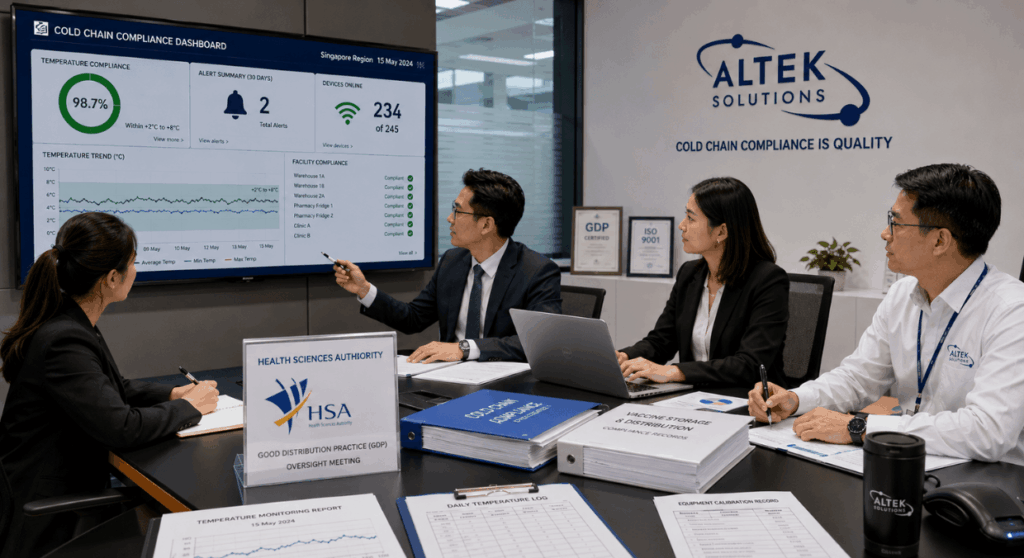
The Health Sciences Authority governs pharmaceutical storage and distribution under Singapore’s Health Products Act and its GDP (Good Distribution Practice) subsidiary guidance. Every wholesale dealer and manufacturer licence for pharmaceutical products includes compliance conditions. GDP guidance specifies not just temperature ranges but monitoring frequency, documentation retention, and excursion management.
MOH and the National Immunisation Registry Framework
MOH’s National Immunisation Registry (NIR) and national vaccination programme guidelines impose additional standards on healthcare providers. Private clinics, polyclinics, and hospital pharmacies administering vaccines under MOH programmes must demonstrate compliance as a condition of participation. These requirements go beyond what a facility would otherwise self-impose.
How WHO Guidelines Align With Singapore’s Regulatory Requirements
WHO’s vaccine storage and handling guidance provides the international reference framework that Singapore’s requirements align with. Where Singapore’s GDP requirements go further, WHO guidance remains a useful supplementary reference for operators working through gaps, particularly for excursion assessment and transport validation.
Temperature Requirements by Vaccine Category
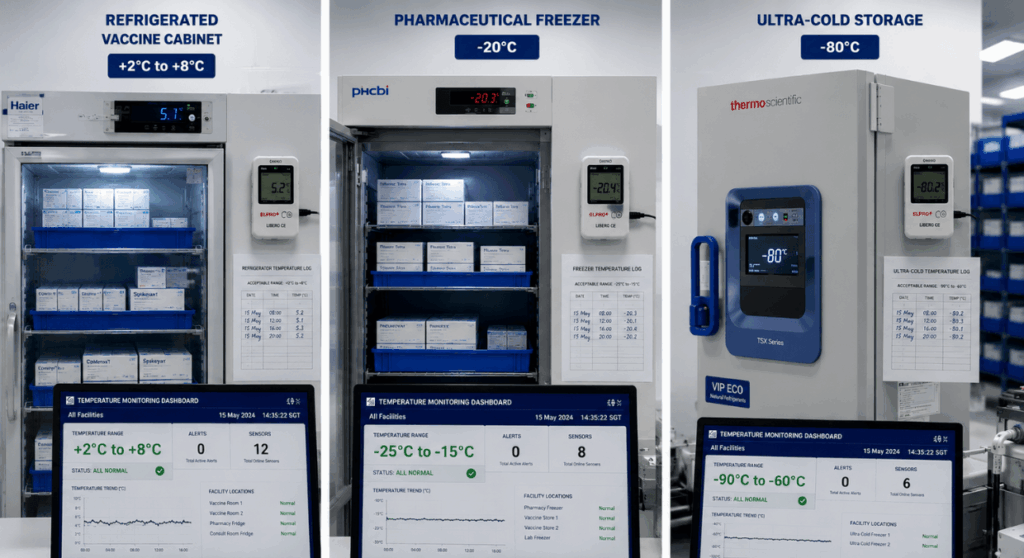
The table below provides a quick reference for the three storage categories before each is explained in detail.
Cold Chain Monitoring Requirements in Singapore
Continuous Temperature Logging: What It Means and Why Spot Checks Are Insufficient
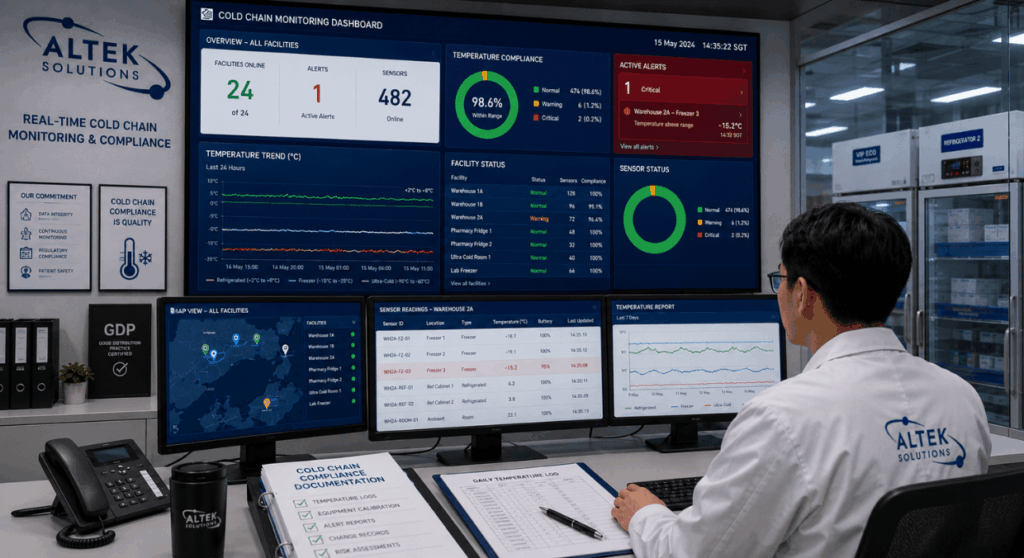
Continuous logging means an unbroken record of temperature readings at defined intervals throughout the entire storage period. Manual readings at shift start and end are not continuous logging. A two-hour excursion between two compliant manual readings is invisible in a spot-check record but clearly visible in a continuous log. HSA’s GDP guidance requires continuous monitoring for all vaccine storage.
Calibrated Data Loggers: What “Calibrated” Means in Practice
The Calibration Frequency Requirement for Temperature Monitoring Equipment
Calibration means verifying the logger’s readings against a traceable reference standard and documenting the outcome. Annual calibration is the typical minimum requirement for storage monitoring equipment. A logger without a current calibration certificate cannot produce a compliance-valid record under Singapore’s regulatory framework. The certificate must be retained alongside the records it supports.
How Altek Solutions and Similar Singapore Data Logger Providers Support Vaccine Cold Chain Monitoring
Altek Solutions is one example of a Singapore-based measurement and data logging equipment provider that supplies calibrated monitoring solutions used in pharmaceutical applications, including vaccine storage monitoring at the intervals and calibration documentation standards GDP compliance requires.
Alarm and Alert Requirements: What Thresholds Must Trigger a Response
Alarm thresholds must activate before the product reaches the excursion limit, not after. The minimum configuration for every storage unit includes a high-temperature alarm, a low-temperature alarm, and a power-failure alarm. Every alarm event must be documented: who was notified, when, what was found, what action was taken, and the outcome. An alarm log without response entries is a compliance gap.
What the Documentation Record Must Include for Regulatory Inspection
The minimum documentation set covers temperature logs with calibration references, alarm event records with response documentation, equipment maintenance and calibration records, and excursion reports with assessment outcomes. Records must be retained for the period specified under Singapore’s Health Products Act licensing requirements. An incomplete or gapped record is treated as evidence of a failed monitoring system during inspection.
Temperature Excursion Management: What to Do When the Cold Chain Breaks
What Constitutes a Temperature Excursion Under Singapore’s Framework
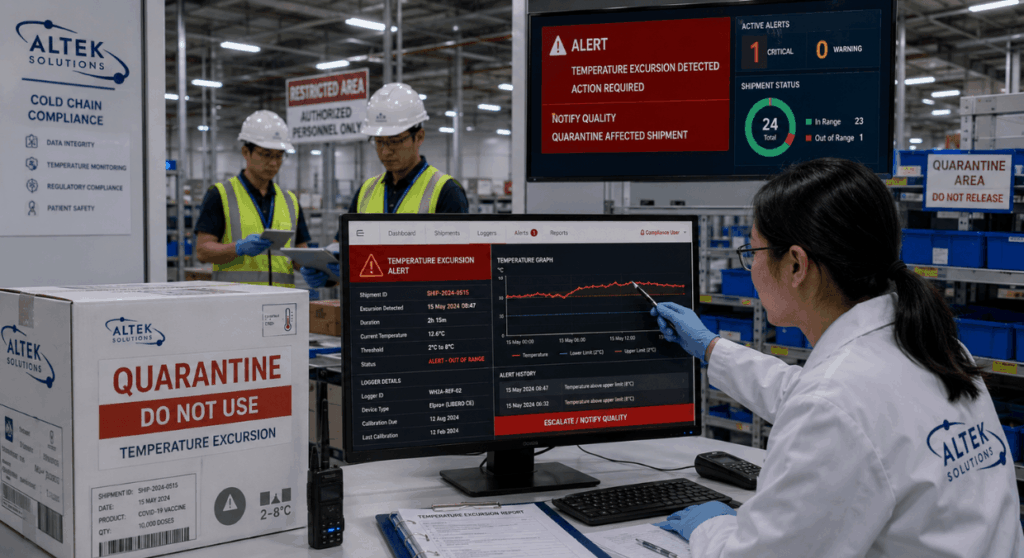
Any deviation from the specified storage range captured in the monitoring record constitutes an excursion, regardless of duration. Even a brief deviation must be documented and assessed. Excursions are classified by duration and severity, and the classification determines the required response level.
The Quarantine and Assessment Protocol for Affected Vaccines
The stock must be quarantined immediately upon identification. Quarantine prevents accidental use before assessment is complete. The assessment must cover product identity, excursion data, and the manufacturer’s stability information. The outcome determines whether to release for use, return to supplier, or discard with documented destruction.
What Mean Kinetic Temperature (MKT) Is and When It Is Used in Excursion Assessment
MKT is a single calculated value representing the cumulative thermal stress a product has experienced. It allows comparison against the product’s stated stability tolerance. It should not be the sole basis for a release decision in three situations: when the excursion was short but severe, when the manufacturer’s stability data is unavailable, or when multiple excursions have occurred in close succession.
The Reporting Requirements When an Excursion Affects Distributed Vaccines
When an excursion has resulted in product distribution before the problem was identified, MOH’s notification channels and HSA’s adverse event reporting framework both apply. The report must cover what was distributed, to whom, when, what the excursion data showed, and what action is being taken. Records supporting a regulatory investigation or patient safety review must be available on request.
Transportation and Last-Mile Cold Chain Requirements
Validated Packaging: What It Means and When It Is Required
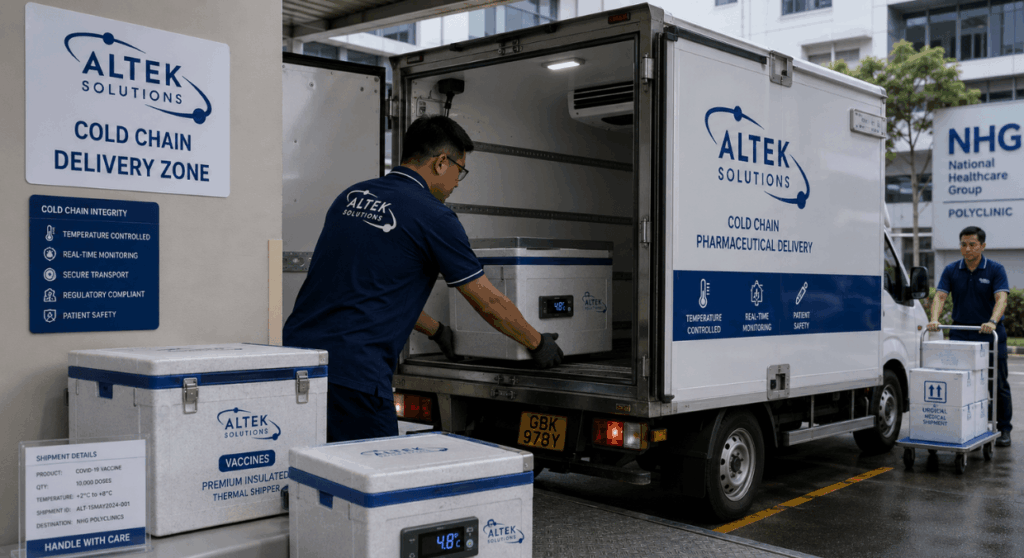
Validated cold chain packaging is a container and coolant system that has been tested to prove it maintains the required temperature range for the intended transit duration. The validation must reflect the actual ambient conditions of the route being used. Validated packaging is required for all pharmaceutical transport where the shipper is responsible for product quality during transit.
Temperature Monitoring During Transport: What Data Must Be Captured
A calibrated logger must capture readings at defined intervals throughout the journey, not only at origin and destination. In-transit data is part of the continuous monitoring record. Any gap between dispatch and receipt that is not covered by a logger record is a documentation gap.
What Cold Chain Transportation Documentation Must Include for Singapore Compliance
A compliant shipment record includes the delivery order or consignment note, the temperature log with a calibration reference, the packaging validation reference, and the receiver’s confirmation of acceptance conditions. The transport record must connect to the receiving facility’s storage log to maintain chain of custody.
How to Assess Whether Your Cold Chain Setup Meets Singapore’s Requirements
The Five-Point Self-Assessment Checklist for Vaccine Cold Chain Compliance
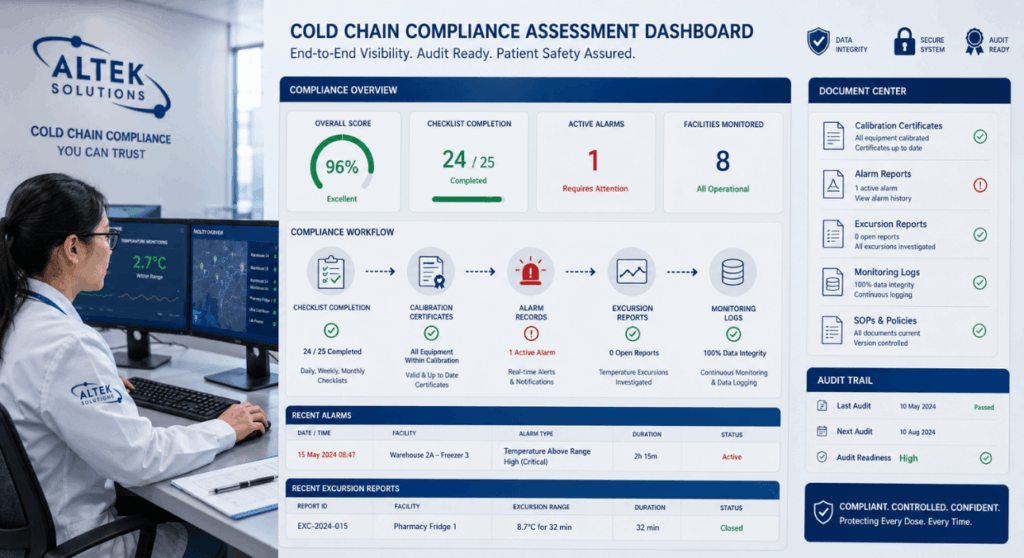
Five questions define whether an operation is compliance-ready. Are temperature ranges defined and documented for each storage unit? Is monitoring continuous and logged to a calibrated device with a current certificate? Is there a documented alarm response procedure? Is there a documented excursion management protocol that covers quarantine, assessment, and reporting? Are all records retained for the required period and available on demand?
What an HSA Inspection Typically Assesses for Cold Chain Compliance
Inspectors review the monitoring records, the equipment calibration certificates, the alarm event log, the excursion records, and the SOPs governing each process. The most common gaps in Singapore pharmaceutical inspections are three: absent calibration certificates, incomplete alarm response records, and excursion records. In the excursion records gap specifically, assessment is often documented as “inspected” with no evidence that a formal assessment was ever conducted.
When Cold Chain Systems Need Revalidation
Equipment replacement, facility modification, product range expansion to a different temperature category, and any significant excursion event all trigger a revalidation requirement. Revalidation must be documented with updated records replacing the previous approval.