
Why Temperature Monitoring Failures Are Usually Predictable
The most surprising truth about temperature monitoring failures is that they are almost never random. A freezer fails silently for three days before anyone notices. A calibration drift goes undetected for months. A sensor placed in the wrong location consistently reads false data. In nearly every case, the failure follows a predictable pattern that existed in the system long before the loss occurred.
How most temperature incidents follow repeatable failure patterns
Temperature monitoring failures don’t surprise systems,they surprise people. The gap between what a system is monitoring and what it should be monitoring creates vulnerability. A single misplaced sensor can leave an entire cold room with a blind spot. An alert threshold set too high will miss the slow temperature creep that eventually ruins product. A battery backup designed without redundancy fails when needed most. These aren’t failures of equipment; they’re failures of design decisions that were made without understanding the actual risks.
Organizations that have experienced temperature excursions often discover the same pattern: the conditions for failure existed long before the incident. A post-event investigation traces the loss back to a decision made months or years earlier,a sensor removed but never replaced, a sampling interval shortened to conserve battery life, an alert silenced because it triggered too often.
Real-world losses traced back to missed or misunderstood risks
Pharmaceutical companies have lost entire batches of temperature-sensitive products because monitoring coverage didn’t extend to a transition zone between storage areas. Cold chain operators have discovered temperature excursions affecting shipments only after products arrived at the customer. Food manufacturers have experienced compliance failures because they treated risk assessment as a one-time exercise, not recognizing that process changes shifted where and how monitoring was needed.
In each case, the organization had monitoring in place. The failure wasn’t the absence of equipment,it was the absence of risk-informed design.
Why monitoring systems fail quietly long before alarms appear
A monitoring system fails silently because it’s designed to fail without being noticed. This happens when an assessment skips the difficult questions: Where is the temperature most likely to exceed limits? What happens when a sensor battery dies? How will anyone know if the network connection drops? A system that doesn’t explicitly address these questions will fail in exactly these ways.
The silence is the problem. By the time an alarm sounds, the damage has often already occurred.
What a Temperature Monitoring Risk Assessment Really Is
A temperature monitoring risk assessment is a structured evaluation of how well your monitoring system identifies and prevents temperature excursions before they damage product or compromise compliance. It’s not a document written to satisfy auditors. It’s a disciplined process to ensure your monitoring design actually protects what matters.
Defining risk assessment in the context of temperature monitoring
Risk vs incident vs deviation: A risk is a potential failure that hasn’t happened yet. An incident is an actual temperature excursion. A deviation is a departure from your documented procedures. Risk assessment focuses on the future,identifying conditions that could lead to incidents before they occur. It asks: “What could go wrong, and are we detecting it?”
Prevention-focused assessment vs post-event investigation: A prevention-focused risk assessment happens before failures. It examines your monitoring design and asks whether it’s adequate. A post-event investigation happens after an incident and asks what went wrong. The former is proactive; the latter is reactive. Effective organizations do the proactive work first.
How risk assessment differs from validation and routine monitoring
Validation proves your monitoring system works as intended under specified conditions. Routine monitoring confirms your system is functioning day to day. Risk assessment asks a different question: Is this monitoring system adequate to prevent failures in your actual operating environment? It combines understanding of your specific process, your product requirements, and your operational reality in ways that generic validation cannot address.
When temperature monitoring risk assessments are expected
New installations, process changes, and audit preparation: Risk assessments are expected when you implement new monitoring, change a process in ways that affect temperature criticality, or when regulatory bodies or customers audit your monitoring program. They’re also expected,though often neglected,whenever you make significant changes to existing systems, such as relocating sensors, changing alert thresholds, or upgrading equipment.
Core Elements of Temperature Monitoring Risk
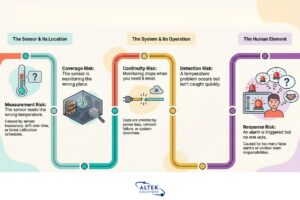
Understanding what can go wrong requires examining five interconnected risk categories:
- Measurement risk: Your sensor reads the wrong temperature. This happens through accuracy limitations, sensor drift over time, or calibration failure. A sensor certified accurate to ±0.5°C at installation may drift beyond that tolerance within months. If you don’t calibrate on a schedule informed by your actual risk, you may not catch the drift until product damage occurs.
- Coverage risk: You’re monitoring the wrong location. Temperature varies across a space. A sensor in a cold room doorway records cooler temperatures than the center of the room. A single sensor in a large warehouse leaves vast blind spots. Coverage risk means your hottest or most variable areas may not be monitored at all.
- Continuity risk: Your monitoring stops when you need it most. Power loss, battery failure, network disconnection, or system downtime create gaps in your record. If a temperature excursion happens during a power outage, an offline backup system, or a scheduled maintenance window, you may never know.
- Detection risk: An excursion occurs but isn’t caught quickly enough. This happens when sampling intervals are too long (checking temperature every 30 minutes means you could miss a 2-hour excursion) or when thresholds are set so high that gradual temperature drift goes unnoticed until damage occurs.
- Response risk: An alarm is triggered, but no one responds. This includes alert fatigue (too many false alarms leading to ignored warnings), unclear ownership of responsibility, or time delays between detection and corrective action. A perfect monitoring system fails if the alert never reaches the right person, or if that person doesn’t understand what to do.
Where Temperature Monitoring Systems Commonly Fail
Storage and controlled environments
Cold rooms, stability chambers, and long-term storage areas are common failure points because they’re assumed to be stable. Yet even controlled environments experience temperature drift from compressor failures, door seal degradation, or thermostat miscalibration. The risk here is that monitoring coverage may be minimal (one sensor assumed sufficient) and maintenance schedules may be infrequent because “nothing usually goes wrong.”
Transport and handoff points
Loading bays, vehicles, and distribution interfaces represent transition zones where many organizations assume temperature is someone else’s responsibility. Products may sit on loading docks during temperature fluctuations, or be transferred between monitored and unmonitored spaces without assessment of the risk.
Process-dependent environments
Manufacturing floors, preparation areas, and holding stages have temperature requirements tied to specific processes. Changes in process,new equipment, layout adjustments, staffing shifts,can invalidate original monitoring placement without anyone explicitly reassessing the risk.
System lifecycle transitions
Maintenance windows, sensor replacements, and system upgrades create periods where monitoring is compromised. If these transitions aren’t managed as high-risk periods, temperature excursions during maintenance may go undetected.
How to Perform a Practical Temperature Monitoring Risk Assessment
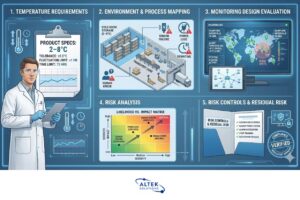
Step 1: Define critical temperature requirements and tolerances
Document what temperatures matter, why they matter, and what the acceptable range is. This includes stability requirements (the product can be at 2–8°C, but can’t exceed ±2°C fluctuation during holding), excursion limits (how far out of range before damage occurs), and duration tolerances (temperature can exceed range for 15 minutes but not longer).
Step 2: Map environments, processes, and failure modes
Create a detailed map of every space, process stage, and transition point where temperature is critical. For each area, identify what could go wrong: sensor failure, power loss, placement inadequacy, human error, or system downtime. Be specific. Don’t just say “equipment failure”,identify which equipment and what happens when it fails.
Step 3: Evaluate monitoring design against identified risks
For each identified risk, assess whether your current monitoring system detects it. Does sensor placement cover all temperature-critical areas, or are there blind spots? Is your sampling interval fast enough to catch rapid excursions? Are alerts configured to catch gradual drift? Is your response procedure clear and tested?
Step 4: Assess likelihood vs impact for each risk
Some risks are highly likely but low-impact (a sensor battery dies, but you have a backup). Others are unlikely but catastrophic (a freezer fails completely, undetected for days). Prioritize your mitigation efforts on high-likelihood, high-impact risks first.
Step 5: Document risk controls and residual risk
For each significant risk, document how your monitoring system controls it. Then honestly assess what risk remains. No system is perfect. The goal is to ensure your residual risk is acceptable and documented.
| Risk Category | Common Failure Mode | Detection Method | Mitigation Example |
| Measurement | Sensor drift undetected | Calibration schedule | Quarterly verification against reference |
| Coverage | Temperature variation in blind spot | Placement assessment | Multiple sensors at high-risk zones |
| Continuity | Power failure during excursion | Backup power system | UPS with 4+ hour autonomy |
| Detection | Slow temperature creep missed | Trend analysis | Alerts set below final limit |
| Response | Alarm ignored or delayed | Escalation procedure | Multi-channel alert to named owner |
Risk Assessment Insights Auditors and Inspectors Expect
Regulatory bodies and customers reviewing your temperature monitoring program expect to see evidence of risk-based thinking. They want to understand why you placed sensors where you did, why your alert thresholds are set as they are, and what happens if something fails. They expect documentation that shows you’ve thought through the risks systematically, not randomly assembled a monitoring system.
Auditors also expect to see clear linkage between identified risks and control measures. If your risk assessment identifies placement as a risk, they expect to see documentation of how placement was evaluated and justified. Organizations that reference structured assessment approaches,including neutral examples observed during reviews of monitoring programs designed with providers such as Altek Solutions Singapore,demonstrate that they’ve applied disciplined methodology, not guesswork.
Additionally, inspectors expect ongoing review and reassessment. A risk assessment from three years ago is evidence that you once thought through the risks, but it’s not evidence that your current system still adequately addresses them.
Common Risk Assessment Mistakes
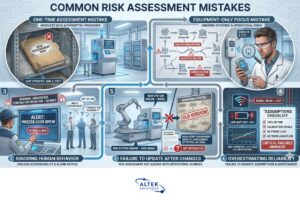
- Treating risk assessment as a one-time document: Creating an assessment, storing it in a folder, and never revisiting it defeats the purpose. Risk assessment must be reviewed whenever processes change, equipment is replaced, or regulatory requirements shift.
- Focusing only on equipment failure, not process failure: Organizations often assess whether sensors and systems will function correctly but overlook how people actually behave. A perfectly designed monitoring system fails if staff regularly silence alarms because they trigger too often, or if responsibility for responding to alerts is unclear.
- Ignoring human response and operational behavior: The most robust technical design can be undermined by poor procedures or unclear accountability.
- Overestimating system reliability without evidence: Assuming a sensor won’t drift, or that network connectivity won’t fail, without evidence is a common trap. Reliability estimates should be based on actual failure data, manufacturer specifications, or operational history.
- Failing to update risk assessments after changes: Process modifications, new equipment, staffing changes, or regulatory updates can invalidate previous risk conclusions. Each significant change should trigger reassessment.
Using Risk Assessment to Prevent Failures Before They Occur
The value of risk assessment emerges when it informs decisions. Prioritize mitigation actions based on real risk,invest in additional sensors for high-risk areas, upgrade calibration schedules for sensors prone to drift, and strengthen procedures for high-consequence failure modes. Strengthen monitoring design where risk is highest. This might mean adding redundancy (backup sensors, backup power), improving coverage (more sensors in variable-temperature areas), or increasing detection speed (shorter sampling intervals for critical processes).
Align your calibration, maintenance, and review schedules to the actual risks you’ve identified. If your assessment identifies power loss as a high-impact risk, your maintenance program should include regular testing of backup systems. If slow temperature drift is a concern, your calibration schedule should reflect that risk, not a generic vendor recommendation. Train your teams to recognize early warning signs. Staff should understand why monitoring is placed where it is, what a normal temperature pattern looks like, and what to do if an alarm is triggered.
This knowledge transforms your team from passive monitor-watchers into active risk preventers. Finally, embed risk assessment into your ongoing monitoring governance. Reassess periodically, incorporate new data from near-misses or minor deviations, and adjust your monitoring design as your process evolves.
Conclusion
Effective temperature monitoring risk assessment is fundamentally proactive, not reactive. It asks what could fail before product is damaged or compliance is compromised. By identifying the failure points in your system,measurement gaps, coverage blind spots, continuity vulnerabilities, detection delays, and response failures,you create the opportunity to strengthen your monitoring where it matters most.
The goal isn’t a perfect system. It’s a system where you understand your real risks, have consciously decided how to address them, and can explain your decisions to auditors, customers, and your own teams. Organizations that take this approach prevent the costly incidents and compliance failures that plague those who treat monitoring as a checkbox exercise. Your temperature monitoring system should reflect the actual risks in your operation. Risk assessment is how you ensure it does.