
Why Your Monitoring Device Choice Matters More Than You Think
If you’re tasked with monitoring temperature in a critical environment,whether pharmaceutical cold storage, food safety compliance, or HVAC system validation,you’ve likely encountered the terms “temperature logger” and “data logger” used interchangeably. The reality is more nuanced. The choice between them can determine whether you maintain compliance, catch problems before they escalate, or face data gaps exactly when you need them most.
Real-world scenarios where the wrong logger caused data gaps or compliance issues
A pharmaceutical distributor chose a basic temperature logger for cold chain transport because it was cheaper and “just needed to track temperature.” Six months into use, a regulatory audit revealed they couldn’t document humidity spikes that might have affected product stability. The logger had no humidity sensor, and retrofitting the monitoring system cost far more than upgrading to a multi-parameter device would have cost initially.
Another example: A food manufacturer deploying a single-parameter logger across 15 freezers discovered when one unit malfunctioned that the device had no cloud backup. Temperature data during the malfunction was lost entirely. Without that data, they couldn’t demonstrate to inspectors that product hadn’t been exposed to unsafe temperatures.
A third case: An HVAC contractor used a temperature-only data logger for building system validation but later needed to include relative humidity measurements to meet updated commissioning standards. Existing loggers couldn’t be upgraded; the entire fleet needed replacement, doubling costs.
These scenarios share a common thread: the initial choice was made without fully understanding what the monitoring system needed to prove.
The false assumption that all loggers measure and store data the same way
The industry terminology is loose. Some manufacturers label a multi-parameter device a “temperature data logger” because temperature is the primary measurement. Others call a single-sensor device a “data logger” simply because it logs data. This semantic confusion masks real technical differences: sampling intervals, memory depth, calibration requirements, software ecosystems, and whether data is stored locally or in the cloud.
A reader might compare two devices side by side, see similar prices, and assume they’re equivalent. But one might store 30 days of high-frequency data while the other stores six months at lower sampling rates. One might require annual calibration certification; the other might not.
Why this decision matters in regulated and long-term monitoring environments
In unregulated, low-stakes environments,like a basement storage area,the choice is less critical. But in cold chain logistics, pharmaceutical manufacturing, food safety, and research settings, the device you choose must align with what regulators, auditors, and your risk profile demand. In Singapore and across regulated markets, pharmaceutical companies must demonstrate unbroken temperature control throughout distribution per Health Sciences Authority (HSA) requirements. Food safety operations must comply with Singapore Food Agency (SFA) standards and HACCP protocols.
Clinical trials demand data integrity with tamper-evident records. Environmental research needs precision and traceability. In these contexts, buying the wrong device isn’t an inconvenience,it’s a compliance gap waiting to happen.
Defining the Basics: What You Need to Know Before Comparing
What a temperature logger is designed to do
A temperature logger is a single-purpose device: measure temperature at regular intervals and store that data for later retrieval. The design philosophy is simple and deliberate. Temperature is the parameter of interest; everything else,sensor, memory, power, software,supports that one measurement mission.
Single-parameter focus and purpose-built temperature tracking
A dedicated temperature logger prioritizes depth over breadth. It may offer fast sampling rates (measurements every few seconds), large memory capacity (thousands of data points), or extended battery life because the single sensor and focused measurement scope keep power consumption low.
Inside every temperature logger sits an internal sensor,like an RTD (Resistance Temperature Detector),that acts as the device’s “nerve.” An RTD is a high-accuracy sensor that changes electrical resistance as temperature shifts; this resistance change is converted into a precise temperature reading. These sensors are carefully calibrated for the specific temperature range relevant to your application,such as -20°C to 0°C for freezer monitoring or 15°C to 25°C for climate-controlled environments. Rather than trying to measure all possible temperatures, they’re optimized to work best within their intended range.
Because there’s only one parameter to measure, the device logic is simpler, the firmware more stable, and the price generally lower than a multi-parameter alternative. Many temperature loggers are small, lightweight, and can be deployed with minimal setup.
Common environments where temperature-only data is sufficient
Temperature loggers are well-matched to applications where temperature is genuinely the only variable that matters. Cold chain transport for temperature-sensitive goods,pharmaceuticals, vaccines, biologics,often requires only temperature verification. A product either stayed within its specified range or it didn’t. Food storage and kitchen compliance checks frequently use temperature-only monitoring. SFA codes and food safety standards often specify temperature thresholds for refrigerators and freezers; relative humidity or other factors aren’t part of the regulatory requirement, though they may matter operationally.
HVAC system commissioning and spot monitoring sometimes need only temperature validation to confirm a system is maintaining setpoint.
What a data logger is designed to do
A data logger is a multi-parameter instrument designed to capture several different measurements simultaneously or in sequence. Where a temperature logger is a single tool sharpened for one task, a data logger is a toolkit that adapts to different measurement needs.
Multi-parameter data acquisition explained
A typical data logger accepts multiple sensors or probes and records data from each one at set intervals. The device might have internal sensors for temperature and humidity and external connector ports for additional probes measuring pressure, voltage, current, light, or motion.
The software allows you to define sampling rates, recording duration, and alarm thresholds for each parameter independently. This flexibility makes data loggers suitable for complex environments where temperature alone doesn’t tell the full story. A data logger can capture temperature, humidity, and pressure simultaneously in a pharmaceutical cleanroom, giving you a complete picture of environmental stability.
Typical inputs such as temperature, humidity, pressure, voltage, and current
Beyond temperature, data loggers commonly measure:
- Humidity – Critical in pharmaceutical storage, museums, and electronics manufacturing, where moisture can degrade products or materials.
- Pressure – Important in sealed systems, altitude-dependent applications, or anywhere barometric shifts indicate environmental changes.
- Voltage and Current – Useful for energy monitoring, battery performance validation, or equipment diagnostics.
- Light – Relevant for light-sensitive materials, artwork preservation, or any application where UV or ambient light exposure affects product quality.
- Acceleration or Vibration – Captures shock or movement, alerting you to handling problems during transport or equipment malfunction.
Why the terminology overlaps in the real world
The boundary between “temperature logger” and “data logger” is blurry because the categories overlap functionally and in how they’re marketed.
How single-parameter devices fit under the broader data logger category
Technically, a temperature logger is a specialized subset of data loggers,a data logger optimized exclusively for temperature measurement. In a strict sense, anything that logs data qualifies as a data logger, including a temperature-only device. However, industry practice uses the terms differently. “Temperature logger” typically refers to a single-parameter, often smaller or simpler device aimed at straightforward monitoring. “Data logger” usually connotes multi-parameter capability and greater sophistication.
Industry naming conventions and marketing-driven labels
Manufacturers, distributors, and marketing sometimes use terminology loosely. A device with temperature plus one additional sensor (like temperature + humidity) might be called either a “temperature data logger” or a “data logger,” depending on the vendor’s framing. This loose naming convention matters because it can obscure real differences. A reader seeing “temperature data logger” from one vendor and “data logger” from another might not realize one is single-parameter and one is multi-parameter.
Design and Technical Differences That Impact Daily Use
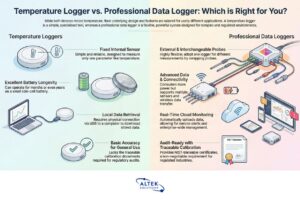
Beyond the conceptual difference, these devices differ in how they’re built and how those design choices affect your day-to-day operations.
Sensor architecture and measurement scope
Fixed internal sensors vs external and interchangeable probes
A temperature logger typically has a fixed internal temperature sensor. You don’t replace it, adjust it, or swap it out. This simplicity is an advantage,fewer points of failure, no calibration headaches with probe connections, and consistent performance across the device’s life.
The tradeoff is inflexibility: if you need to measure a different parameter, you need a different device.
Data loggers, especially those aimed at professional and research applications, often accept external probes. An internal sensor might measure ambient conditions, while detachable external sensors measure specific points in a process. This modularity lets you adapt the same logger to different applications by simply changing the probes. A pharmaceutical facility might use one data logger with different temperature probes for different storage zones rather than buying separate devices.
Data storage, sampling, and power considerations
Memory depth, sampling intervals, and battery trade-offs
Temperature loggers excel at long monitoring periods because they consume minimal power. A logger sampling temperature every 5 or 10 minutes can run for months on a small coin-cell battery. Memory capacity is substantial because a temperature reading is a small data point,a logger with 32KB of memory can store tens of thousands of readings, translating to months or years of data depending on sampling rate.
Data loggers, especially multi-parameter versions, consume more power because they’re gathering multiple sensor inputs and often maintaining wireless connectivity or a brighter display. A data logger with the same battery might last weeks rather than months. The trade-off matters for your use case. A cold chain shipment lasting 7 days is easily covered by either device. A year-long environmental monitoring project might favor a temperature logger for battery longevity.
Software ecosystems and data accessibility
Local software, cloud platforms, and data export formats
Many temperature loggers use simple local software: connect the device to a computer via USB, launch the manufacturer’s app, and download the logged data. The data appears in a basic table or graph, exportable to CSV or PDF. This approach is straightforward but limits real-time monitoring,you have to physically retrieve the device to see what’s happened.
Data loggers increasingly include cloud platforms where data uploads automatically (if the logger has wireless capability) or at regular intervals. You can monitor trends from anywhere, set remote alarms, and generate automated reports. For enterprises managing monitoring at scale, the initial complexity is worth the long-term operational simplification.
Accuracy, calibration, and traceability expectations
Calibration intervals and documentation requirements in audits
This difference is easily overlooked but critically important in regulated environments. A basic temperature logger might carry a manufacturer specification like “±0.5°C” but without traceable calibration documentation. For casual monitoring, that’s sufficient.
But if an audit requires you to prove that your measurements were accurate on a specific date, you need calibration certificates,documented proof that the device was tested against a known standard and fell within tolerance. Think of this like a vehicle inspection: you can drive safely without one, but regulators require proof that your vehicle meets standards.
In Singapore, pharmaceutical audits rely on NIST-traceable calibration. Here’s why this matters: NIST traceability creates an unbroken “Evidence Chain” that proves to HSA inspectors that your measurements weren’t just taken,they were independently verified against a globally recognized national standard. This chain of verification is what separates compliant operations from ones that face regulatory findings. Without it, even accurate data can be challenged because there’s no proof of verification.
Pro-Tip: When an HSA audit occurs, inspectors specifically ask: “Can you show us the calibration history?” This documentation is non-negotiable in regulated pharmaceutical environments.
Calibration costs money and time. Many temperature loggers aren’t designed for annual calibration and recertification. Data loggers, especially those marketed for professional or research use, often support formal calibration programs. The manufacturer provides calibration services, supplies calibration reports, and supports data integrity logging that documents when the device was last checked. If your application is regulated,pharmaceutical distribution, medical device storage, clinical trials, food safety compliance,calibration capability and traceability are non-negotiable.
Quick Comparison: Temperature Logger vs Data Logger at a Glance
| Feature | Temperature Logger | Data Logger |
| Measurement Parameters | Temperature only | Temperature + 2–5 additional parameters (humidity, pressure, voltage, etc.) |
| Sensor Type | Fixed internal | Fixed internal + external interchangeable probes |
| Battery Life | 3–12 months (typical) | 2–8 weeks (typical, multi-parameter) |
| Memory Capacity | 32–256 KB (thousands of readings) | 1–16 MB (millions of readings) |
| Data Access | USB or local software | USB, cloud platform, or real-time web dashboard |
| Calibration Support | Basic or none | Formal, with NIST-traceable certificates |
| Best For | Cold chain, food safety, spot checks | Industrial process, research, multi-location oversight |
| Price Range | $100–500 | $500–3,000+ |
| Ease of Deployment | Very high | Moderate to high |
| Future-Proofing | Limited | High (modular probe design) |
Use Cases: Where the Choice Becomes Clear
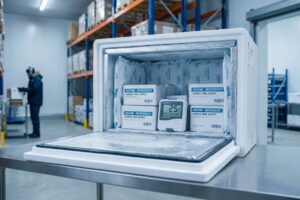
Scenarios best suited for temperature loggers
Cold chain logistics and pharmaceutical transport
Temperature loggers are purpose-built for cold chain validation. A pharmaceutical shipment needs proof that the product remained within 2°C to 8°C from warehouse to hospital. A temperature logger records that data efficiently, is small enough to fit in a shipping box, and costs little enough to integrate into logistics workflows.
The audit question is simple: “Did temperature stay in range?” The logger answers it directly. Many temperature loggers in this space are designed for single-trip use,they log the shipment, data is retrieved, and then they’re reused. This makes per-shipment cost manageable and simplifies the logistics chain.
Food storage, kitchens, and retail compliance checks
SFA standards and food safety protocols require temperature monitoring of refrigerators, freezers, and hot holding units. A temperature logger placed in each unit provides the necessary compliance documentation. The question is straightforward: “Did the freezer stay at -18°C or below?”
Retail and food service operations often use dozens of temperature loggers across multiple locations. Cost-effectiveness and ease of deployment (minimal training, simple data retrieval) make temperature loggers the practical choice.
HVAC validation and spot monitoring
When commissioning an HVAC system or validating that a building maintains setpoint, temperature loggers provide quick, simple verification. You place a logger in a space, confirm the system maintains temperature, and the logger proves it. For routine spot checks,”Is the conference room at 21°C?”,a temperature logger is appropriately scoped and cost-effective.
Scenarios best suited for data loggers
Complex Multi-Variable Environments: Industrial Process Monitoring, Equipment Diagnostics, and Energy Systems
Manufacturing and industrial operations often need multiparameter insight. A food processing line might need to monitor temperature during cooking, humidity as product cools, and pressure in closed vessels,all simultaneously and with synchronized timestamps. A single data logger captures this complexity far better than deploying separate devices for each parameter.
Equipment diagnostics also favor data loggers. Diagnosing a refrigeration unit malfunction might require simultaneous temperature and pressure readings to understand whether the compressor is working correctly.
Similarly, buildings, data centers, and utility systems need to understand energy consumption patterns holistically. A data logger can simultaneously measure temperature (to understand HVAC load), humidity (to assess moisture/mold risk), and electrical parameters (power, current, voltage) to build a complete energy picture. This multi-variable approach reveals correlations,for example, discovering that humidity spikes occur exactly when HVAC cycles, suggesting airflow problems.
Environmental monitoring and research studies
Scientific research often demands precise, multi-parameter data. An ecological study might monitor temperature, humidity, light, and soil moisture across multiple locations over months or years. A research data logger with external probes is far more practical than deploying four different single-parameter devices at each location. Environmental compliance monitoring,say, validating air quality or thermal discharge into a waterway,typically requires more than temperature alone.
Grey areas where either option could work
Short-term studies vs long-term continuous monitoring
A short-term study,validating a new freezer over two weeks,might use a simple temperature logger because the scope is narrow and the monitoring window small. The same question asked over two years of continuous monitoring might favor a data logger if you need to correlate temperature changes with humidity or other variables. The decision hinges on whether single-parameter monitoring truly answers the question or whether deeper context will eventually become necessary.
Projects with potential future expansion needs
A manufacturing plant deploying temperature loggers in one warehouse might later need to expand to relative humidity monitoring across multiple facilities. An initial choice of single-parameter loggers creates technical debt,adding humidity means replacing devices, retraining staff, and redesigning data workflows. Starting with a multi-parameter data logger and using only the temperature function initially leaves room for expansion without rework.
Practical Comparison Factors That Influence Buying Decisions
When you’re actually choosing between a temperature logger and a data logger, several practical factors should guide your decision.
Measurement scope and future-proofing
Ask yourself: What parameters must I measure now? What might I need to measure in two years? If your honest answer is “only temperature, and that’s unlikely to change,” a temperature logger is the right fit. If you’re uncertain or suspect you’ll eventually need humidity, pressure, or other data, investing in a data logger’s flexibility now saves replacement costs later. This decision isn’t about speculation,it’s about understanding your industry. Pharmaceutical companies know that regulations and customer requirements evolve.
Ease of deployment and ongoing operation
Temperature loggers generally win on ease of use. Small form factor, simple setup, minimal training. If you’re deploying dozens of devices across a large organization, the cumulative time savings matter. Data loggers, especially cloud-connected versions, have steeper initial setup but potentially lower ongoing operational overhead. Once configured, they can generate reports automatically, send alarms, and consolidate data from multiple locations into a single dashboard. For enterprises managing monitoring at scale, the initial complexity is worth the long-term operational simplification.
Reporting depth and data analysis needs
Does your compliance or operational framework require simple threshold validation (“was temperature in range?”), or do you need to analyze trends, correlate parameters, and generate detailed reports? A temperature logger produces straightforward reports: “Device recorded 500 readings; minimum 2.1°C, maximum 7.8°C; all within specification.” That’s often sufficient.
A data logger allows deeper analysis: “Temperature ranged 2–8°C; humidity ranged 30–65%; overnight hours showed temperature drift correlating with humidity spikes, suggesting inadequate dehumidification.” Choose the reporting depth that matches your actual needs,not what sounds impressive.
Total cost of ownership beyond upfront price
The device itself is only part of the cost. Consider these ongoing expenses:
- Calibration – Budget $50–200 per year per device. Many temperature loggers lack formal calibration support, while data loggers designed for professional use assume annual recertification.
- Probe Replacement – External probes on data loggers may need replacement every 2–3 years, adding $30–100 per probe depending on sensor type.
- Software Licensing – Some data loggers charge annual subscription fees ($100–500/year) for cloud platforms or advanced reporting features.
- Battery and Maintenance – Small batteries in temperature loggers require regular replacement ($10–20 per replacement), while some data loggers support rechargeable batteries or external power (reducing long-term costs).
- Upgrade Cycles – A temperature logger chosen for a short-term project might be discarded afterward. A data logger chosen for scalability might serve multiple purposes over 5 years, lowering per-application cost.
- Example Calculation: A $150 temperature logger with annual calibration ($100/year × 5 years) costs $650 total. A $800 data logger with $150/year calibration costs $1,550 over 5 years,but if it serves three different monitoring projects, the per-project cost drops to $517.
Calculate total cost of ownership across your intended application period, not just the purchase price.
Integration with existing monitoring or compliance systems
If you already have a data management system, LIMS, or compliance tracking platform, evaluate how well candidate loggers integrate. Some export to open formats compatible with your existing workflow; others require manual data transfer or re-keying. A data logger that exports to your existing system reduces administrative overhead.
Common Buying Mistakes and How Experienced Teams Avoid Them
Choosing based solely on price instead of application fit
The cheapest logger isn’t always the best value. A temperature logger that costs half the price of a multi-parameter data logger looks appealing in a spreadsheet, but if you ultimately need humidity measurement and have to replace the logger fleet, the initial savings evaporate. Experienced procurement teams compare total cost across the intended application period, accounting for calibration, integration, and potential feature gaps.
Overestimating the need for multi-parameter data
The opposite mistake is equally common: assuming you need a data logger because it’s more capable, then deploying only temperature measurement and ignoring the unused functionality. Evaluate honestly whether you’ll actually use additional parameters. A multi-parameter device is justified when you have a genuine measurement need, not because it sounds more impressive.
Underestimating regulatory, audit, and documentation requirements
Buyers new to regulated industries often underestimate how much documentation matters. You select a cheap logger, deploy it for a year, then face an audit and discover it lacks calibration traceability. Now you’re replacing it and scrambling to reconstruct historical data defensibility.
Before choosing, research your compliance requirements explicitly. If audits or regulatory reviews are part of your environment, assume documentation matters more than convenience. In Singapore, HSA audits of pharmaceutical distributors regularly focus on calibration documentation. Ensure your selected device supports formal calibration with verifiable certificates.
Ignoring environmental factors like moisture, vibration, or extreme temperatures
A logger specified for -10°C to +50°C might seem sufficient for a warehouse. But if that warehouse experiences temperature swings from freezing in winter to 60°C in certain areas, you need a device rated for the actual extremes, not assumed ones.
Similarly, humidity and moisture can damage or degrade both devices, but especially those with sensitive electronics or connectors. A logger deployed in a coastal humid environment needs better moisture resistance than one in a climate-controlled office. Vibration and shock matter too. A logger in a vehicle or manufacturing area experiences physical stress. Some devices are hardened for these conditions; others aren’t. Specify the device based on the actual environment it will face, not an idealized version of it.
Assuming all loggers support the same calibration and data retention standards
Different manufacturers support different calibration approaches, data retention periods, and compliance documentation. A device that claims “ISO 9001 compatible” might simply mean the manufacturer has quality processes,it doesn’t guarantee your specific compliance framework is supported.
Before purchasing, confirm:
- Whether formal calibration is available and at what cost
- Whether calibration certificates are provided and in what format
- Whether the device supports data logging that records when it was last calibrated
- How long manufacturer support for data retrieval and format conversion is guaranteed
These specifics prevent discovering after purchase that your chosen device doesn’t align with your audit requirements.
How to Decide: Your Selection Roadmap
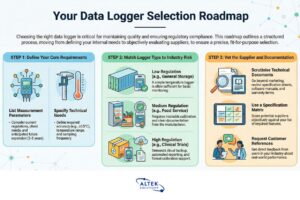
Making a good choice requires asking the right questions and matching the device to your actual requirements.
Key questions to answer before selecting a device
What parameters must I measure now and in the future?
List the parameters required by:
- Current regulations or compliance standards
- Customer or client requirements
- Your own operational quality needs
- Anticipated future expansion (next 3–5 years)
Be honest about “future-proofing” fantasies. If you truly won’t need humidity measurement, don’t pay for it. But if your industry is evolving toward multi-parameter monitoring, account for that.
What accuracy, resolution, and sampling frequency do I actually need?
Define specifics:
- What temperature range must be covered?
- What accuracy is required (±0.5°C, ±0.1°C, ±2°C)?
- How often must measurements occur (every 1 second, every 5 minutes, every hour)?
- How long must data be retained (days, months, years)?
These specifications drive the device type. A cold chain shipment lasting 7 days needs minimal memory; environmental monitoring over years needs deep storage or cloud backup.
Matching logger type to industry risk and compliance level
Different industries impose different documentation demands:
- Low-regulation environments (e.g., general storage): A simple temperature logger is often appropriate. The risk if something goes wrong is manageable, and proof of temperature maintenance is sufficient.
- Medium-regulation environments (e.g., food service, some pharmaceuticals): Calibration traceability and clear documentation become important. A temperature logger with manufacturer support and calibration availability is prudent.
- High-regulation environments (e.g., clinical trials, pharmaceutical distribution, medical device manufacturing): Comprehensive documentation, often multi-parameter, is critical. A data logger with cloud backup, automated reporting, and formal calibration support is the baseline expectation.
Understand your actual compliance level before selecting a device.
Evaluating technical documentation and support objectively
Don’t rely on marketing claims. Request and review:
- Specification sheets detailing accuracy, range, and operating conditions
- Software documentation showing data export formats and reporting capabilities
- Calibration options and costs
- Warranty and support terms
- User manuals and training resources
Evaluate whether the documentation actually answers your questions or deflects them with jargon. Good documentation demonstrates expertise; poor documentation suggests the manufacturer hasn’t thought deeply about user needs.
Assessing suppliers: A structured evaluation approach
When evaluating potential suppliers, structured assessment prevents bias and ensures you’re comparing like to like. Create a specification matrix listing your required features, accuracy, compliance support, and integration needs. Score each candidate device objectively against that matrix, rather than focusing on price or brand familiarity.
When evaluating any supplier, apply this same objective assessment:
- Review their product range against your defined requirements
- Confirm their local calibration services and traceability support
- Validate compatibility with your compliance framework and audit standards
- Request reference customers in your industry who can speak to real-world performance
For localized suppliers in your market, consulting with specialists like Altek Solutions Singapore ensures your hardware isn’t just accurate, but also fully compliant with HSA/SFA audit standards and designed specifically for pharmaceutical, food safety, and industrial applications in the region.
Direct feedback from users facing problems similar to yours is invaluable. The goal is fit-for-purpose selection, not vendor preference.
Planning for Long-Term Success After Purchase
Selecting the right device is the foundation. Ensuring it delivers value requires planning for deployment, calibration, and lifecycle management.
Pilot testing before full-scale deployment
Don’t deploy 50 devices based on a datasheet review. Acquire one or two units, test them in your actual environment for at least the timeframe you’ll be monitoring.
Confirm:
- Does the device operate reliably in your actual temperature, humidity, and vibration conditions?
- Is the software interface usable for your staff?
- Do data export and reporting meet your actual needs?
- Is manufacturer support responsive and helpful?
Pilot testing catches incompatibilities before large-scale investment.
Calibration schedules and data integrity planning
If your application requires traceable calibration, establish the schedule and workflow immediately:
- When will devices be calibrated (every year, every two years)?
- Who will handle the logistics (send to manufacturer, use a third-party lab)?
- How will you store and organize calibration certificates?
- How will you log which device was calibrated on which date so auditors can match data to calibration status?
Data integrity planning includes:
- How will you protect data from accidental deletion or modification?
- How long will you retain data (often required to match product shelf life or regulatory retention periods)?
- Will cloud backup be used, and how will you ensure data availability if the vendor’s service changes?
Maintenance, storage, and lifecycle considerations
Temperature loggers and data loggers are sensitive instruments. Proper storage extends their life:
- Store devices in moderate temperature and humidity when not in use
- Avoid physical shock or vibration during transport
- Check battery status regularly and replace before depletion
- Keep connectors clean and dry (especially important for data loggers with external probes)
Plan for lifecycle replacement. No device lasts forever. As devices age, batteries degrade, firmware becomes unsupported, and calibration costs may increase relative to replacement cost. Understand when replacement becomes economical.
When it makes sense to upgrade from a temperature logger to a data logger
As your organization matures and monitoring requirements evolve, upgrading becomes justified:
- If you’ve deployed temperature loggers but now need humidity, pressure, or other parameters, a data logger makes sense
- If you’re managing monitoring across multiple locations and need centralized visibility, a cloud-based data logger improves operational oversight
- If compliance requirements have expanded, a data logger’s richer reporting and documentation support is valuable
- If your staff is now trained and processes are mature, the complexity of a multi-parameter system is manageable
Upgrade strategically, not reactively. Plan the transition during your next refresh cycle rather than disrupting an established system mid-deployment.
Conclusion
Key differences between temperature loggers and data loggers
Temperature loggers are single-parameter devices designed for straightforward temperature monitoring. They’re simple, cost-effective, and require minimal deployment overhead. Data loggers capture multiple parameters simultaneously, offering flexibility and deeper insight into complex processes. The choice between them isn’t about features,it’s about matching the tool to the actual problem.
How understanding use cases prevents overspending and underperformance
Cold chain logistics, food storage, and HVAC spot checking often need only temperature loggers. Industrial process monitoring, environmental research, and multi-parameter compliance require data loggers. Understanding your actual use case prevents two equally costly mistakes: overpaying for capabilities you won’t use, or underbuying and discovering mid-project that you lack critical measurement parameters. The most expensive logger purchase is the one that doesn’t fit the application. The best investment is the one chosen after honest assessment of requirements.
Final guidance on making a confident, fit-for-purpose monitoring decision
Before purchasing, define your parameters, specify your accuracy requirements, understand your compliance framework, and pilot the device in your actual environment. Choose based on application fit, not price or convenience. Plan for calibration, long-term data management, and eventual replacement. Remember that a logger that perfectly suits your current need may not serve you well in two years as requirements evolve. Balance immediate fit with reasonable flexibility for future change. The right choice is the one that gives you confidence that you’re capturing the data you need, that you can defend it under audit, and that you understand what it actually means for your operation. That clarity is worth far more than the difference between logger types.