
TL;DR – Key Takeaways
- A temperature excursion is a compliance event the moment it occurs, not after you decide how serious it is.
- The 7-step response: confirm and timestamp → quarantine → root cause investigation → stability assessment → release or reject decision → notify HSA if required → close the CAPA
- Documentation quality determines your audit outcome more than the excursion itself.
- Electronic data logger records with tamper-evident timestamps are what HSA and SFA inspectors expect (not retrospective paper logs).
- Expired calibration certificates can invalidate an otherwise complete response file.
- Set alert thresholds of 1°C–2°C within the excursion limit (not at the limit) to create a response window.
- Every excursion requires a CAPA, regardless of severity.
When the Alarm Goes Off, Why the Next Hour Matters More Than You Think
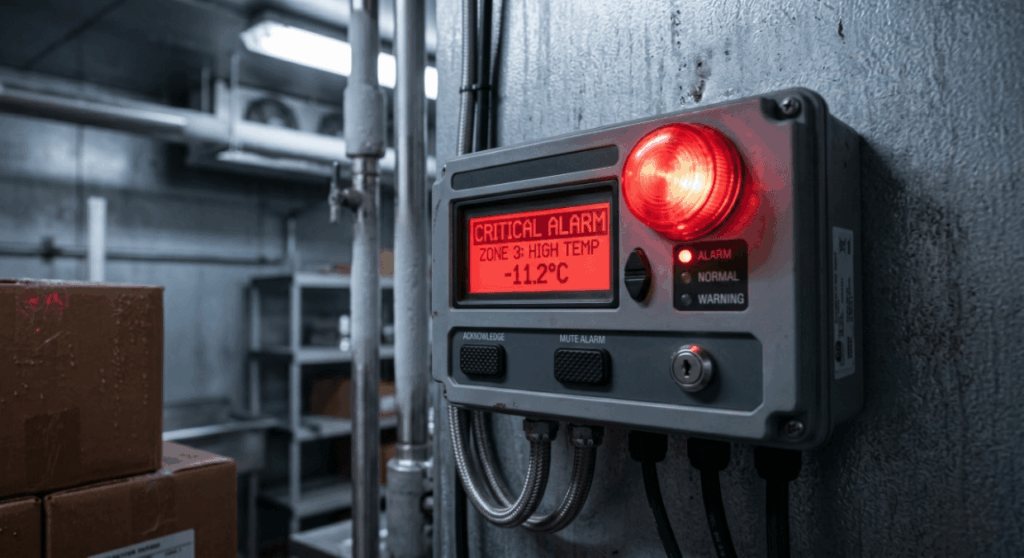
What a temperature excursion actually means in a regulated facility
A temperature excursion is any instance where a temperature-sensitive product is exposed to conditions outside its validated storage range, even briefly. In Singapore’s regulated food and pharmaceutical sectors, “briefly” is not a qualifier that reduces your obligation. It is a trigger that starts a clock.
Why returning to range is not the end of the story
When a refrigerator recovers after a spike, the instinct is relief. In practice, products inside may already have experienced thermal stress. Without documentation proving otherwise, an auditor has no basis to accept your release decision. The temperature record is not just a log. It is your only evidence.
The compliance risk that most teams discover too late
Temperature excursion failures that reach the audit stage are rarely about the excursion itself. They are about the response. Missing timestamps, undocumented quarantine decisions, and incomplete CAPA records are what turn a manageable event into a regulatory finding. The excursion is the incident. The response determines your compliance standing.
Understanding Temperature Excursions Before You Can Manage Them
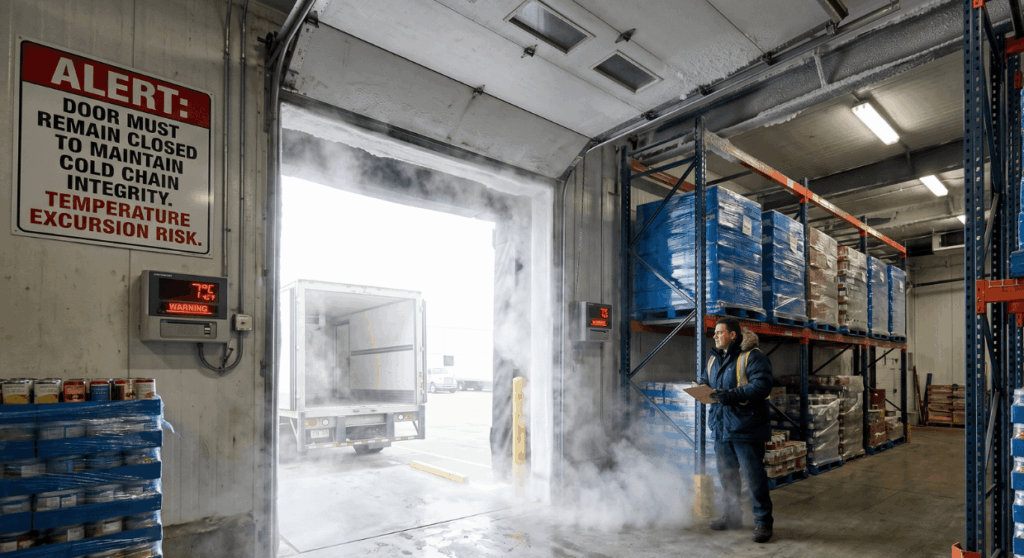
How regulators define a temperature excursion, HSA, SFA, and HACCP perspectives
Singapore’s Health Sciences Authority requires pharmaceutical licence holders to maintain documented procedures for temperature deviations, including investigation, impact assessment, and corrective action, as outlined in the HSA Guidance Notes on Good Distribution Practice (GUIDE-MQA-013). The Singapore Food Agency enforces cold chain requirements that mandate temperature-controlled food products be stored and transported within specified ranges, with monitoring records maintained at all times. See SFA’s responsibilities for food establishment operators. Under HACCP frameworks, an excursion at a Critical Control Point constitutes a critical limit breach requiring immediate corrective action.
The difference between a deviation, an excursion, and a breach
These terms are often used interchangeably, but they carry distinct operational meanings. A deviation is any departure from a specified condition; it may or may not be critical. An excursion refers specifically to a temperature departure from a validated storage or transport range. A breach implies a confirmed violation where product integrity or regulatory compliance is compromised. The distinction matters because your response procedure, investigation depth, and notification obligations differ at each level.
Which product categories carry the highest excursion risk in Singapore’s tropical climate
Singapore’s ambient temperature averages 30°C, with year-round high humidity. That baseline creates structural risk across all cold chain operations, particularly during loading, transfer, and door-opening cycles.
Pharmaceutical cold storage (2°C-8°C and ambient CRT products)
Refrigerated pharmaceuticals, vaccines, biologics, and insulin are among the most excursion-sensitive categories. Even short exposures above 8°C can compromise efficacy. Controlled room-temperature products (typically 15°C-25°C) face risks during outdoor transfers in Singapore’s climate.
Food storage and cold chain under SS 668:2020
Chilled food products (0°C-4°C) and frozen goods (below −18°C) are the primary categories under SFA regulation. Cold chain breakdowns during last-mile delivery are a common source of excursions, particularly in humid loading bay environments.
How temperature excursions actually occur, and why the real causes surprise most teams
Power interruptions are the obvious cause. Less obvious ones account for more incidents: door seal failures allowing warm air infiltration over hours; refrigeration unit servicing not logged as a planned deviation; product placed too close to the evaporator causing localised freezing; and monitoring devices with depleted batteries that silently miss an overnight excursion.
The 24-Hour Excursion Response Protocol, Step by Step
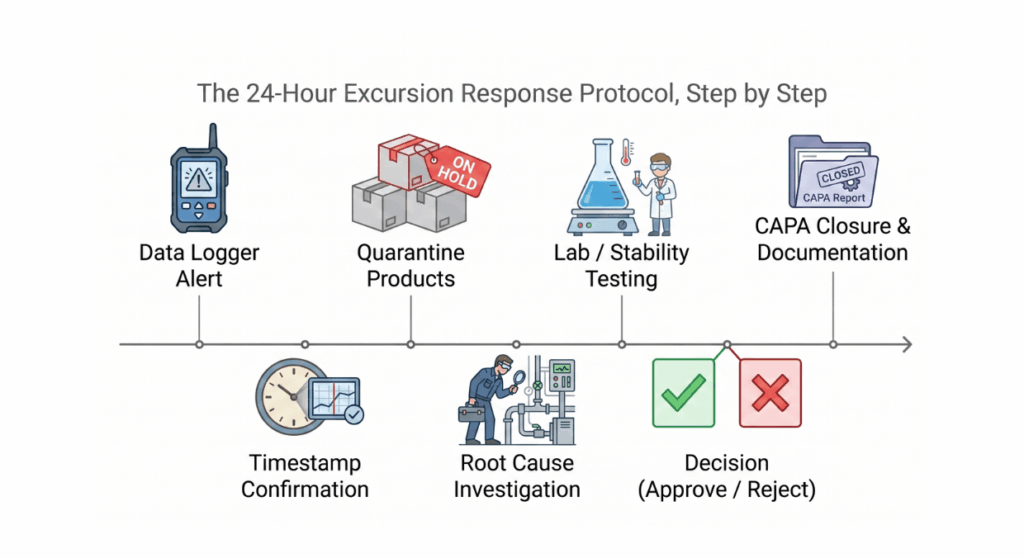
Step 1 – Confirm and timestamp the excursion immediately
Do not act on assumptions. Pull the data logger record before taking any other action. Confirm the start and end times, peak temperature, and duration of the excursion.
- What your data logger record must capture to be audit-valid – A compliant temperature record must include: device ID, calibration certificate reference, date and time stamps for the excursion window, temperature values at the defined logging interval, and any alert notifications generated. Records from a calibrated, certified logger carry evidentiary weight that manual logs cannot replicate.
- Why retrospective manual entries create liability – A handwritten log completed two hours after an excursion, even if accurate, creates a credibility gap that auditors will question. Electronic data loggers with tamper-evident timestamps are the standard that HSA and SFA inspectors expect.
Step 2 – Quarantine affected products without delay
- All products within the affected storage zone during the excursion window must be physically quarantined and clearly labelled “On Hold, Pending Investigation.” Under GMP and HACCP frameworks, quarantine is a mandatory control, not a precautionary one.
- How to label quarantined stock correctly under GMP and HACCP – Labels must include: product name and batch number, date and time of quarantine, reason for hold, and the name of the responsible person. Labels must be tamper-evident and physically affixed to the product, not placed nearby.
Step 3 – Identify the root cause before making any release decision
- The investigation must establish whether the excursion was caused by equipment failure, process failure, or human error. That distinction drives your corrective action.
- Equipment failure vs process failure vs human error: why the difference matters for CAPA – A failed thermostat calls for an equipment-focused response. A staff member propping a cold room door open calls for procedural and training-based action. A CAPA (Corrective and Preventive Action) plan that treats both scenarios identically will not satisfy a regulatory reviewer and will not prevent recurrence.
Step 4 – Conduct a stability impact assessment
- What pharmaceutical facilities must evaluate before releasing or rejecting stock? – The stability assessment must reference the product’s validated temperature excursion budget and the cumulative time and temperature exposure that the manufacturer has confirmed does not compromise quality. Without this reference, no release decision can be scientifically justified.
- What food facilities must document under the SFA cold chain requirements? – Food facilities must document the excursion duration, peak temperature, product type, and the basis of any sensory or microbiological risk assessment used to support a release or disposal decision. For high-risk categories, ready-to-eat products, raw meat, and dairy, the default position under HACCP is disposal unless a qualified food safety professional approves release in writing.
Step 5 – Make the release, recondition, or reject decision with documented justification
- The decision and its basis must be recorded in writing, signed by an authorised person, and retained as part of the batch or lot record. A verbal decision is not a compliant record.
Step 6 – Notify relevant parties where required
- When HSA notification obligations are triggered – Licence holders must notify HSA when a temperature excursion results in, or has the potential to result in, compromised product quality for goods already distributed. Consult your specific licence conditions and the HSA GDP Standards page for current reporting thresholds.
- Internal escalation vs external reporting thresholds – Not every excursion requires external notification. Establish clear internal escalation criteria, excursion duration, product category, and distribution status, so the right people are engaged at the right level without unnecessary escalation of minor events.
Step 7 – Close the CAPA loop before the next audit cycle
- A CAPA without a verification step is incomplete. The corrective action must be implemented, its effectiveness confirmed, and the result documented before the file can be closed. Open CAPAs rank among the most common audit observations in Singapore pharmaceutical and food facility inspections.
What Your Documentation Must Include: The Audit-Ready Standard
Document | What It Must Contain | When to Prepare It |
Excursion Log | Device ID, timestamps, temperature values, duration | Immediately upon detection |
Quarantine Record | Product details, batch number, hold reason, and responsible person | Within 1 hour of detection |
Root Cause Investigation | Equipment, process, or human cause; evidence reviewed | Within 24 hours |
Stability Impact Assessment | Reference to the validated excursion budget or risk basis | Before the release or rejection decision |
Release / Reject Decision | Decision basis, authorised signatory, date | Before the stock movement |
CAPA Record | Corrective action, target date, verification result | Closed before next audit cycle |
The three documentation errors that turn a manageable event into a regulatory finding
Missing the quarantine timestamp. Releasing stock without a written stability assessment. Closing a CAPA record without documented verification. Each of these, individually, has triggered compliance observations in Singapore facility audits.
How calibration certificate currency affects the credibility of your excursion data
When a data logger’s calibration certificate expires during an excursion, the temperature record it generates becomes legally questionable. Regulators cannot confirm that the device was measuring accurately. That single gap can invalidate an otherwise complete response file.
Electronic records vs paper logs: What GMP and HSA GDP guidelines expect
The WHO Guideline on Data Integrity (TRS 1033, Annex 4), adopted as a reference standard by HSA, requires GMP records to meet ALCOA+ principles: attributable, legible, contemporaneous, original, and accurate. Paper logs completed retrospectively fail the “contemporaneous” requirement and should not serve as the primary excursion record.
Common Mistakes Singapore Facilities Make During Excursion Response
Waiting for the temperature to self-correct before logging the event
Every minute without a timestamp is a minute your response record cannot account for. Log the event the moment the alert triggers, not after you have decided what to do about it.
Releasing quarantined stock based on a visual check alone
Visual inspection does not confirm thermal stability. A product can look, smell, and test normal while its cold chain integrity has been compromised. Release decisions must rest on documented assessment, not observation.
Treating every excursion the same, regardless of duration or severity
A 30-minute excursion to 10°C for a refrigerated pharmaceutical demands a different investigation depth than a 4-hour excursion to 25°C. Proportional response is appropriate, but the basis for that proportionality must be documented.
Missing the CAPA requirement because the excursion seemed minor
Severity does not determine whether a CAPA is required. Any excursion that reaches a critical limit under your monitoring plan requires corrective action documentation. “It won’t happen again” is not a CAPA.
Building a Proactive Excursion Prevention System
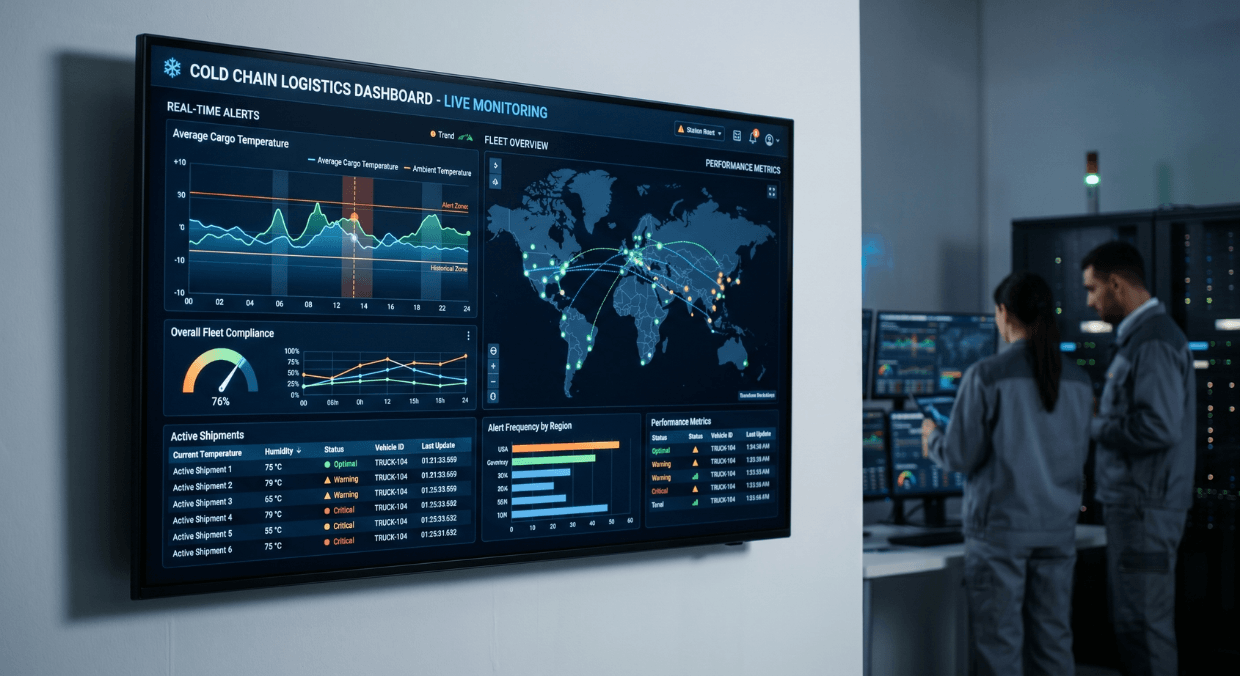
How the monitoring interval frequency determines how early you detect an excursion.
A data logger sampling every 30 minutes can miss a short but significant excursion that peaks and recovers between intervals. For high-risk pharmaceutical storage, intervals of 5–15 minutes provide meaningful detection capability. The WHO Technical Supplement on Temperature Mapping of Storage Areas recommends recording intervals between 1 and 15 minutes for pharmaceutical storage environments.
Setting alert thresholds inside the excursion limit, not at it
Alert thresholds set at the excursion limit leave no response window. Setting alerts 1°C–2°C inside the storage limit provides time to investigate and intervene before a product-compromising excursion occurs.
How Altek Solutions approaches excursion-ready monitoring configurations for regulated Singapore facilities
Altek Solutions, a Singapore-based precision measurement instruments supplier, configures data loggers with pre-alert thresholds and calibration schedules aligned to HSA and SFA monitoring requirements, reducing the time lag between detection and response.
Staff training as a compliance control: what auditors look for beyond the equipment
Auditors review training records as part of excursion investigations. A facility with the right equipment but no documented staff training on the response procedure will receive an observation, regardless of how well the protocol was followed in practice.
Frequently Asked Questions
HSA notification is required when an excursion results in, or is likely to have resulted in, compromised product quality for goods that have already been distributed. Consult GUIDE-MQA-013 and your specific licence conditions for exact thresholds. When in doubt, regulators view proactive disclosure more favourably than delayed reporting.
Pharmaceutical facilities should retain temperature records for the product’s shelf life plus one year, with some GMP obligations extending to five years. Food facilities should align retention periods with their HACCP plan and SFA licence conditions. Always confirm the requirement against your specific product category.