
Why Humidity Errors Are Often Discovered Too Late
How minor humidity deviations quietly invalidate compliance data
A 3% humidity drift sounds trivial. A pharmaceutical cold storage facility receives an audit notice six months later discovering that 40 days of temperature and humidity data has been rejected because the humidity logger was drifting outside tolerance. The temperature readings,which were accurate,are now worthless without corresponding humidity verification. Compliance data isn’t compartmentalized. A 2–3% drift in humidity monitoring can invalidate months of otherwise reliable environmental records, especially in regulated industries where humidity and temperature act as paired data points.
The problem: humidity deviations often remain invisible until audits expose them. Unlike temperature, which operators notice through environmental controls and comfort levels, humidity drift is silent. A data logger displaying 45% relative humidity (RH) might actually be reading 48% or 42%. The facility continues operating with confidence in invalid data.
Real-world scenarios where “acceptable” readings fail audits
A food processing facility maintains continuous humidity monitoring for packaging operations. Internal trend analysis shows stable readings between 35–40% RH. An external audit reveals the sensor drifted to 33% RH,outside specification,rendering the last 120 days of data questionable. The facility must now justify whether product quality was affected, document product fate decisions, and implement corrective actions.
A pharmaceutical warehouse maintains two humidity loggers in climate-controlled storage. One consistently reads 0.5% lower than the other. Neither has been recalibrated in 18 months. An FDA inspection identifies the discrepancy and requests documentation proving sensor accuracy. Without current calibration certificates, the facility cannot demonstrate traceability, triggering a compliance observation.
An electronics laboratory uses humidity data loggers for cleanroom monitoring. A technician checks the instrument against a simple moisture meter and notices a 2% difference. She assumes it’s acceptable variation. No recalibration occurs for another year. When audited, the lack of documented validation between instruments becomes a compliance gap, not because the readings were necessarily wrong, but because accuracy was never verified.
Why humidity is more sensitive to drift than most users expect
Humidity sensors drift faster than temperature sensors due to their design and environment. Relative humidity depends on absolute atmospheric moisture and temperature,measure either incorrectly, and humidity calculations fail. A 1°C temperature error can produce a 2–3% RH error. Over months, dust, salt particles, and chemical vapors contaminate sensor elements, degrading accuracy. Condensation exposure accelerates this process dramatically.
Manufacturers typically specify ±3–5% RH accuracy for standard data loggers. This range already represents significant uncertainty in tight compliance environments where tolerances are ±2–3% RH. Once drift begins, it accumulates. A sensor drifting at 0.5% RH per month reaches unacceptable levels in 4–6 months, yet appears stable in day-to-day readings.
Understanding Humidity Measurement and Calibration Basics
What a humidity data logger actually measures
Relative humidity explained in practical terms
Relative humidity measures how much moisture air contains relative to its maximum capacity at that temperature. The same absolute amount of moisture creates different RH values at different temperatures. A data logger measures moisture content and calculates RH based on temperature. If either the moisture sensor or temperature sensor drifts, the RH value becomes unreliable.
Interaction between temperature and humidity readings
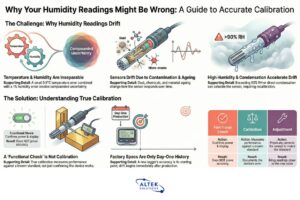
Temperature and humidity are inseparable in environmental monitoring. A 1% humidity error combined with a 0.5°C temperature error creates compounded uncertainty. Auditors reviewing pharmaceutical storage data expect both readings to demonstrate consistency and traceability. If temperature is certified accurate but humidity is not, the paired data lacks credibility even if the temperature portion is reliable.
What calibration means for humidity data loggers
Calibration vs adjustment vs functional checks
Calibration measures actual performance against known standards, documenting the difference between displayed readings and true values. Adjustment physically corrects the sensor to match standards. A functional check confirms the device powers on and displays numbers,this proves nothing about accuracy.
Many facilities confuse “we tested it” with “we calibrated it.” A functional check is not calibration. Comparison against another uncalibrated instrument is not calibration. Only testing against traceable standards with documented uncertainty establishes true calibration.
Why factory accuracy is only a starting point
A humidity logger leaves the factory with ±2.5% RH specification. This is the manufacturer’s guarantee at the moment of production,not a promise about future performance. From that point forward, drift begins. The factory calibration is historical data, not current validation.
Why humidity sensors are inherently prone to drift
Effects of contamination, aging, and exposure
Humidity sensor elements are typically polymer or ceramic materials that absorb and release moisture. Over time, contaminants bind to the sensing surface: dust particles, salt spray, cleaning agent residue, and volatile organic compounds. Aging also changes the sensor’s response characteristics. A sensor accurate at 50% RH may gradually shift by 1–2% as it ages.
Impact of condensation and high-humidity environments
Environments exceeding 90% RH or experiencing condensation expose the sensor to saturation. Once moisture condenses directly on the sensor, recalibration becomes essential. The sensing element loses its baseline response. High humidity environments in food production, pharmaceutical manufacturing, and cold storage expose sensors to more aggressive conditions than laboratory environments,accelerating drift.
Why Small Humidity Errors Create Disproportionate Risk
Narrow compliance margins in regulated environments
Pharmaceutical storage requires ±2–3% RH tolerance around the set point. Food production HACCP plans specify ±5% RH in some zones, but moisture-sensitive packaging requires tighter control. An undetected 2% drift consumes half or all of the allowable compliance margin, leaving no safety buffer for natural process variation.
Compounding errors in long-term monitoring data
A facility monitors humidity for 6 months continuously. If the sensor drifts 0.3% per month, by month 5, the error reaches 1.5%. By month 12, it exceeds 3%. All data collected during drift is now questioned. Batch records, product stability claims, and shelf-life justifications tied to those readings become suspect.
False stability masking real environmental issues
Drifted sensors can appear stable while hiding real environmental problems. A humidity logger slowly drifting upward from 45% to 50% RH might mask an actual facility control problem. Operators see “stable” data and don’t investigate root causes. Months later, audits reveal the logger was wrong, but real humidity may have been even higher,potentially affecting product quality undetected.
When humidity inaccuracies invalidate temperature data as well
Environmental data is submitted to regulators as paired measurements. Temperature and humidity jointly establish the environmental profile. If humidity calibration is questioned, auditors lose confidence in the entire dataset, including temperature readings. This forces revalidation of both sensors even if temperature was accurate.
Calibration Frequency: How Often Is Humidity Enough?
Manufacturer guidance vs real operational conditions
Manufacturers typically recommend annual calibration for humidity loggers. This is baseline guidance, not a compliance requirement. Real operational conditions often demand more frequent calibration. A logger deployed in pharmaceutical manufacturing should be calibrated every 6–9 months. A logger in stable laboratory conditions might sustain annual calibration. A logger in food production with condensation exposure needs 6-month intervals.
Risk-based calibration intervals
| Risk Level | Industry Example | Humidity Tolerance | Calibration Interval | Compliance Consideration |
| High | Pharmaceutical storage, cold chain | ±2–3% RH | 6 months | Product stability, batch records critical |
| Moderate | Food production, HVAC systems | ±3–5% RH | 9 months | HACCP compliance, regulatory risk |
| Low | Trend monitoring, non-critical storage | ±5–10% RH | 12 months | General awareness, quality trending |
High-risk environments with strict tolerance limits
Pharmaceutical stability chambers, blood bank storage, and controlled room temperature storage demand tight humidity control. A 0.5% drift is problematic. Calibration every 6 months ensures you detect drift before it affects compliance data. Uncertainty in calibration must be documented and factored into acceptance criteria.
Moderate-risk storage and production areas
Food production facilities, HVAC monitoring spaces, and archive storage have wider tolerances but still face regulatory scrutiny. 9-month intervals balance cost with risk. However, if environmental conditions are unusually harsh (condensation, vibration, chemical exposure), escalate to 6-month intervals.
Low-risk trend monitoring scenarios
Non-critical facilities using humidity data for general awareness and trend analysis can sustain annual calibration. The risk of compliance failure is lower, but data credibility still depends on documented calibration history.
Events that require immediate recalibration
Sensor saturation or condensation exposure
If a humidity logger is exposed to condensation or deployed in an environment that exceeds its operating range and then corrects, recalibrate immediately. The sensing element may have been altered.
Physical shock, cleaning, or relocation
Dropping a data logger, cleaning the sensor housing, or moving it to a dramatically different environment can affect accuracy. Document these events and recalibrate within 30 days.
Compliance Expectations Tied to Humidity Accuracy

Industries where humidity calibration is critical
Pharmaceuticals and controlled storage
FDA guidance and ICH Q1A(R2) expect documented environmental monitoring with calibrated instruments. Humidity calibration certificates with traceability are standard audit expectations. Out-of-tolerance results must trigger investigation and documented corrective action.
Food production and packaging
HACCP plans reference humidity requirements. FSMA compliance expects verification that monitoring equipment is calibrated and accurate. Third-party auditors (SQF, BRC) specifically review calibration records for humidity sensors in critical control points.
Electronics, laboratories, and archives
Electronics manufacturing requires documented humidity calibration for cleanroom monitoring. Calibration and Measurement Capabilities (CMC) laboratories must maintain traceable humidity standards. Archives and museums preserving sensitive materials need annual humidity verification.
What auditors expect to see in humidity calibration records
Traceability and uncertainty reporting
Auditors expect calibration certificates showing traceability to national standards (NIST in the US, or equivalent). The certificate must state the sensor’s measured values at each calibration point, plus the uncertainty of the calibration itself (typically ±1–2% RH). As-found and as-left data shows drift magnitude and whether adjustment was performed.
Calibration intervals and corrective actions
Documented calibration intervals demonstrate a planned, risk-based approach. When a sensor is out of tolerance, auditors expect documented investigation: How long was it out? What products or batches were affected? What corrective actions were taken? Can data from that period be salvaged with statistical adjustment, or must it be invalidated?
Common compliance failures linked to humidity monitoring
The most frequent failure is missing calibration records. The second is expired calibration with no recalibration date planned. The third is calibration intervals longer than operational risk justifies. A fourth failure is failure to investigate out-of-tolerance results. Auditors view these as control failures suggesting data integrity issues extend beyond humidity.
Humidity Calibration Methods and Their Trade-Offs
Salt solutions, humidity chambers, and reference instruments
Salt solution calibration uses saturated salt baths at known RH points (33%, 43%, 75% at standard temperature). Cost is low; accuracy is ±1–3% RH. Humidity chambers (electrolytic or pneumatic) provide ±0.5–2% RH accuracy but cost significantly more. Reference instruments measure RH against primary standards,these are used to validate facility calibration equipment.
Accuracy limits and practical constraints
Salt solutions are accessible but time-consuming; sensors must equilibrate for 30–60 minutes per point. Chambers are faster but expensive. Most organizations use external calibration services with traceable humidity chambers. The uncertainty of that service becomes part of your compliance record.
Single-point vs multi-point humidity calibration
When single-point checks are insufficient
A single-point check at 50% RH validates performance at one location. A sensor may be accurate at 50% but drift differently at 30% or 75%. Multi-point calibration (typically 33%, 50%, 75% RH) reveals response curve problems. For pharmaceutical and food applications with variable humidity requirements, multi-point calibration is expected.
Interpreting humidity calibration certificates
Understanding uncertainty, tolerances, and pass-fail criteria
A certificate stating “measured 45.2% RH, uncertainty ±1.5%” means the true humidity was between 43.7–46.7% RH during calibration. If your tolerance is ±3% RH, then a displayed reading of 45% is acceptable. If tolerance is ±2%, it may be acceptable. The certificate’s uncertainty must fit within your operational tolerance,if it doesn’t, the calibration service isn’t suitable for your application.
How organizations compare calibration capabilities, including neutral technical reviews involving providers such as Altek solutions during documentation assessments
When selecting a calibration service, organizations review technical capabilities, uncertainty documentation, and turnaround times. During vendor assessments, neutral technical reviews compare how different providers document accuracy, uncertainty, and traceability. Services like Altek solutions participate in these documentation assessments, demonstrating how their calibration data supports compliance requirements. The focus is on the quality of documentation and traceability,not on any single provider, but on how organizations systematically evaluate which service best matches their compliance obligations.
Building a Humidity Calibration Strategy That Prevents Compliance Gaps
Defining acceptable humidity tolerances by application
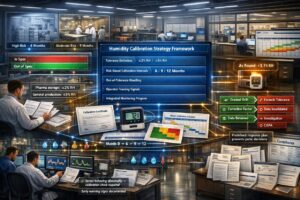
Start by reviewing your regulatory requirements, SOPs, and product specifications. What is the actual humidity tolerance for each monitoring point? Pharmaceutical storage may require ±2% RH; general production may allow ±5%. Define this first,it drives calibration frequency and method selection.
Aligning calibration schedules with environmental risk
High-risk locations (pharmaceutical storage, cold chain) get 6-month intervals. Moderate risk gets 9 months. Low risk gets 12 months. But factor in local conditions: condensation exposure, vibration, chemical atmosphere, and temperature swings accelerate drift. Adjust intervals accordingly.
Managing out-of-tolerance results without data loss
When a sensor is found out of tolerance, investigate the as-found date. If drift is gradual and detected quickly, you may apply a correction factor to historical data with documented justification. If drift exceeds your tolerance margin or persists for months, data validation becomes more difficult. A documented approach,developed before out-of-tolerance events occur,prevents panic decisions.
Training teams to recognize early signs of humidity sensor failure
Train operators to notice discontinuities: sudden jumps in readings, inconsistency between adjacent sensors, or readings that don’t match facility conditions. Document these observations. They’re early warning signs that calibration is overdue or the sensor is failing.
Integrating humidity calibration into broader environmental monitoring programs
Humidity calibration is not separate from temperature, pressure, or differential humidity. Build a master calibration schedule covering all instruments, with documented risk assessments for each. Include calibration costs in budget planning, and assign clear ownership for scheduling and follow-up.
Conclusion
Why small humidity calibration errors create large compliance risks
Humidity sensors drift silently, and 2–3% error easily exceeds compliance tolerances. Once detected, months of data become questionable, triggering investigations, corrective actions, and audit findings. The cost of missed calibration far exceeds the cost of timely calibration.
How proper calibration frequency protects data credibility
A documented, risk-based calibration strategy demonstrates control. High-risk environments get frequent calibration. Out-of-tolerance results are investigated immediately. Auditors see a systematic approach and confidence in your environmental data.
Key takeaways for maintaining trustworthy humidity monitoring in regulated environments
Define your tolerance margins. Establish calibration intervals based on risk. Use calibration services with documented uncertainty that fits your tolerances. Train teams to recognize sensor problems. Investigate out-of-tolerance results promptly. Integrate humidity calibration into your broader environmental monitoring program. These steps ensure that your humidity data remains trustworthy, compliance-ready, and defensible during audits.