
In the digital age where data reigns supreme, imagine being able to predict potential equipment failures before they occur. With a real-time view of your energy consumption, allowing you to identify areas of waste and implement strategies to reduce your carbon footprint – Enter the data logger, the humble device that has emerged as a game-changer for businesses seeking to harness the power of information. It is also a powerful device that silently collects and records data, unlocking a treasure of insights waiting to be explored.
What are data loggers used for? These gadgets can monitor and track a wide range of parameters, from temperature and humidity to energy consumption and equipment performance, providing a comprehensive picture of your operations. Data loggers are powerful tools that can unlock valuable insights and empower businesses to make data-driven decisions, ultimately leading to increased efficiency, cost savings, and improved performance.
The Power of Data-Driven Decisions.
Listen up, my friends. In today’s competitive business landscape, data is the new gold, and those who know how to mine it are striking it rich. That is where our trusty data loggers come into play, collecting precious information like it is nobody’s business.
According to a study by the MIT Sloan Management Review, data-driven organisations are a whopping 23 times more likely to acquire customers, six times more likely to retain them, and a jaw-dropping 19 times more likely to be profitable. Gathering and analysing data from every aspect of your operations allows you to make decisions based on cold, hard facts rather than relying on gut feelings.
But wait, there is more. This data-driven approach is not just about boosting your bottom line; It also promotes a culture of ongoing development, allowing you to pinpoint areas that need a little more attention and implement targeted strategies to optimise them to perfection.
Imagine being able to predict when a piece of equipment is about to cause some chaos, giving you a chance to schedule maintenance before it causes any costly disruptions. How about having a real-time view of your energy consumption so you can identify those sneaky energy vampires and fix them with eco-friendly solutions? That is the kind of power we’re talking about
But here’s where things get really interesting. Data loggers also play a crucial role in keeping your business straight and narrow regarding industry regulations and standards. In sectors like healthcare, food processing, and pharmaceuticals, where the rules are tighter than an extra small outfit, these bad boys provide a reliable paper to keep you out of trouble.
Unlocking Insights Across Industries.
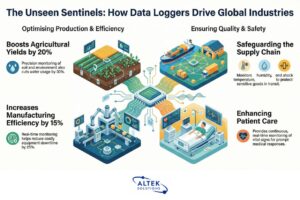
Data loggers’ versatility extends far beyond a single industry. Let’s explore a few diverse examples to appreciate the true breadth of their impact.
Agriculture Industry.
In the ever-evolving world of agriculture, data loggers have emerged as invaluable allies for farmers seeking to maximise yields and optimise resource utilisation. By monitoring soil moisture, temperature, and other environmental factors, these devices provide critical insights that enable precision farming techniques. Farmers can make informed decisions on irrigation schedules, crop selection, and pest management, ultimately increasing productivity and reducing waste.
A case study from the University of California demonstrated a 20% increase in crop yields and a 30% reduction in water usage after farmers implemented data loggers in their farming operations. This translated into increased profitability for farmers and contributed to sustainable practices by minimising water consumption and promoting more efficient resource utilisation.
Imagine being able to monitor the microclimates within your fields, allowing you to tailor your farming strategies to specific areas based on monitored data and having real-time alerts that notify you when the soil moisture levels drop below optimal levels, ensuring that your crops receive the precise amount of water when they need it.
Manufacturing Industry.
In the growing manufacturing industry, efficiency is the king, and data loggers are the knights in shining armour. These devices offer a comprehensive view of the manufacturing process by tracking production line performance, equipment temperature, and energy consumption. This real-time monitoring empowers manufacturers to identify bottlenecks, optimise resource allocation, and implement preventive maintenance strategies.
A leading automotive manufacturer reported a 15% increase in production line efficiency and a 25% reduction in downtime after implementing data loggers, resulting in substantial cost savings and improved customer satisfaction. But that is not all. Data loggers also play a significant role in ensuring product quality by monitoring environmental conditions that can impact the manufacturing process.
Imagine being able to predict equipment failures before they occur, allowing you to schedule maintenance during planned downtimes and minimise disruptions to your operations. Also, having a real-time view of your energy consumption enables you to identify waste areas and implement strategies to reduce your carbon footprint and operational costs.
Data Loggers in Logistics.
This is not only true in the agriculture and manufacturing industry but also in logistics, where timing is crucial and temperature-sensitive items are at risk. These devices precisely monitor temperature conditions during transportation to ensure the quality of goods such as pharmaceuticals and food items and maintain their integrity throughout the supply chain. By providing detailed temperature logs, data loggers enable logistics companies to identify potential issues and take corrective actions immediately.
It is not just about temperature monitoring; data loggers can also track factors like humidity, shock, and vibration, ensuring that delicate products arrive at their destinations in pristine condition.
Healthcare Industry.
Last but certainly not least, let’s talk about the healthcare industry, where lives are on the line. Data loggers play a crucial role in ensuring patient safety and well-being. They continuously monitor vital signs such as body temperature, heart rate, and blood pressure. These devices provide healthcare professionals with real-time data, enabling them to make informed decisions and respond promptly to any changes in a patient’s condition.
Imagine tracking a patient’s vitals remotely, allowing for continuous monitoring without disrupting their daily activities. It’s like having a team of highly skilled medical professionals on call 24/7, but way more convenient and less expensive.
Choosing the Right Data Logger for Your Needs.
Now that we’ve got you all excited about the wonders of data loggers, it’s time to choose the right one for you. With the vast array of data loggers available on the market, selecting the right one for your specific needs can be a headache. But don’t worry. We’ve got you covered with a step-by-step guide on choosing the right one.
First, assess your monitoring requirements. Determine the parameters you need to track, such as temperature, humidity, energy consumption, or equipment performance. This will help you narrow down your options and ensure that the data logger you choose is equipped with the appropriate sensors. For example, if you are in the food industry, you will likely prioritise temperature and humidity monitoring to ensure product quality.
Next, consider the number of channels you need. If you need to monitor multiple parameters simultaneously, go for a data logger with multiple input channels to accommodate your needs seamlessly. This is particularly important in industries like manufacturing, where you may need to simultaneously track various aspects of your production line.
Don’t forget about data storage capacity. Depending on your sampling rate and the duration of your monitoring period, you have to ensure that the data loggers can store sufficient data without the risk of overwriting or losing valuable information. Let’s be honest; nobody wants to be responsible for losing data, right? A high-capacity data logger would be ideal for long-term environmental monitoring projects.
The communication interface is another crucial factor to consider. You will need to access data remotely or transfer it to a computer for analysis. Look for data loggers with wireless connectivity or USB interfaces to facilitate seamless data transfer. This feature can be handy in logistics industries where real-time monitoring and alerts are essential.
Battery life is also critical, especially for remote or long-term monitoring applications. Choose a data logger with a long-lasting battery or the option for external power sources to ensure uninterrupted data monitoring. This is crucial in applications like environmental monitoring, where data loggers may be deployed in remote locations for extended periods.
Finally, let’s not overlook the budget. While data loggers can be a beneficial investment, their prices can vary significantly based on features and capabilities. Determine your budget and prioritise the most essential features for your business needs. Investing in high-quality data loggers can pay dividends in the long run through increased efficiency, cost savings, and improved decision-making.
Utilising Data Logger Data Effectively.
Collecting data is only half the battle because this is where the real magic happens. The true power lies in effectively analysing and extracting valuable insights from the information gathered. However, data loggers will be helpful if you need to learn how to analyse and extract valuable insights from that information effectively. Fortunately, various software tools and resources are available to assist you.
Data visualisation software such as spreadsheet programs or specialised data analytics platforms can transform raw data into visually appealing and easy-to-make charts, graphs, and reports that will make you go “WOW”. These visual representations can reveal patterns, trends, and outliers that might otherwise go unnoticed, providing a comprehensive understanding of your operations.
Also, consider leveraging data analysis techniques such as statistical modelling, machine learning algorithms, or predictive analytics to uncover deeper insights and make data-driven predictions about future scenarios. These advanced analytical tools can help you stay ahead of the rest in an increasingly competitive market.
Conclusion.
In the evolving business world, data loggers have become vital allies that provide priceless insights and data-driven transformation. From optimising agricultural practices to streamlining manufacturing processes by monitoring temperature-sensitive goods during transportation and ensuring patient safety in the healthcare industry, these devices have proven their worth repeatedly.
So what are you waiting for? Embrace the data-driven revolution and explore the vast potential of data loggers. Whether you’re a farmer seeking to maximise yields, a manufacturer striving for optimal efficiency, a logistics company committed to ensuring product integrity, or a healthcare provider thinking about patient safety, these little marvels can be the key to unlocking game-changing insights.
Do you still have questions? Do you need guidance on implementing data loggers in your business? Don’t hesitate to reach out. We’re here to support you on your journey towards your success. Together, we can unlock the power of data loggers and transform your business into a powerhouse.