
Food safety audits fail for a surprising reason: organizations have thermometers and record-keeping processes, yet still can’t prove continuous temperature control. The difference lies in one critical distinction,owning monitoring equipment is not the same as operating a monitoring system. This guide explains why end-to-end food temperature monitoring matters for compliance, how it actually works, and how to build one that stands up to inspection.
Why Food Temperature Failures Still Happen Despite “Monitoring”
Real compliance failures caused by missed temperature excursions
Regulatory investigations reveal a consistent pattern: facilities experience food safety incidents not because they ignored temperature control, but because their monitoring approach left blind spots. A storage unit fails overnight, but temperature isn’t checked until morning,by then, product has already moved through the supply chain. A freezer door is left partially open during preparation, but no one notices because monitoring relies on manual checks every few hours instead of continuous recording.
These aren’t hypothetical scenarios. They appear in FDA warning letters and inspection reports. They prompt product recalls and loss of customer confidence.
The gap between spot checks and continuous monitoring
Organizations often rely on staff to check temperatures at specific intervals,opening a refrigerator, reading a dial thermometer, and writing the result on a clipboard. This approach creates a false sense of control. What happens during the eight hours between checks? Was the compressor running the entire time? Did the door seal fail briefly? Continuous monitoring fills these gaps. It captures what actually happened every minute, not just the moments when someone happened to look.
Why food safety incidents often trace back to incomplete systems, not bad intent
Most food operators genuinely care about safety. The problem isn’t neglect,it’s that fragmented monitoring creates unintended vulnerabilities. One person monitors refrigeration, another tracks cooking temperatures, a third manages transport. Records live in different systems or locations. When an incident occurs, nobody can quickly assemble a complete, time-stamped history of temperatures that product experienced. Compliance fails not because the organization failed to care, but because the system itself was never truly connected end-to-end.
What a Food Temperature Monitoring System Really Is
Defining end-to-end food temperature monitoring
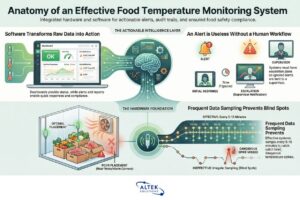
A complete food temperature monitoring system integrates four essential components working together: sensors that measure temperature continuously, devices that record that data, software that analyzes and alerts on deviations, and documented records that prove what happened. Remove any one piece, and the system breaks.
Sensors, data capture, alerts, and records as one system: The sensors measure. The data loggers or monitoring devices capture readings at regular intervals (typically every 5–15 minutes). The software layer processes that data, compares it against defined thresholds, and triggers alerts when temperatures drift out of safe ranges. The record layer documents everything with timestamps, creating an auditable trail. These four elements must communicate and work together, not exist as separate tools.
Difference between manual logs and automated monitoring: Manual logging depends on human consistency. Someone must remember to check the thermometer, write down the number accurately, and record the time correctly. Automated monitoring removes human memory from the equation. A sensor records the temperature whether or not anyone is thinking about it. Data flows continuously into a system that never forgets, never misreads a dial, and never loses a record.
Where temperature control matters across the food lifecycle
Temperature control isn’t a single checkpoint,it’s a series of critical control points that must all work together.
Receiving and storage: When food arrives at your facility, its temperature sets the baseline for everything downstream. A product that’s already warm when received starts at a disadvantage. Cold chain maintenance during storage prevents spoilage and pathogen growth. Freezing must maintain product integrity; refrigeration must hold safe temperatures continuously.
Preparation and cooking: Cooking temperatures must reach levels that eliminate pathogens specific to each protein type. A beef roast requires different internal temperatures than chicken. Holding prepared food at safe temperatures prevents rapid bacterial multiplication during service.
Holding, transport, and delivery: Hot food must stay hot; cold food must stay cold. During transport, temperature fluctuations can occur from vehicle failure, door openings, or environmental conditions. Delivery monitoring ensures product arrives at the destination within acceptable temperature ranges.
Common misconceptions about “having a monitoring system”
Why thermometers alone are not a system: A wall-mounted dial thermometer tells you the temperature right now. It doesn’t tell you what happened six hours ago. It doesn’t alert you when temperatures drift. It creates no record that regulators can audit. It cannot be placed in every critical location. A thermometer is one tool; a system is an integrated solution.
Limits of periodic manual checks: Manual checks create data only at the moments when checks occur. If you check every four hours, you’re missing 22 hours of daily data. Equipment failures often happen outside business hours. One missed check,because a staff member was sick, or a facility was busier than usual,can create a data gap that regulators view skeptically.
Core Components of an Effective Food Temperature Monitoring System
Temperature sensors and probes
Fixed vs portable sensors: Fixed sensors live permanently in refrigerators, freezers, or holding units. They monitor one location continuously and send data wirelessly or via direct connection to the monitoring system. Portable sensors move with products or are carried to different monitoring points. Each approach has trade-offs. Fixed sensors reduce setup effort but don’t follow food through transport. Portable sensors track product movement but require manual positioning and management.
Placement mistakes that distort readings: Sensor placement is more complex than it appears. Placing a sensor near cold air return vents reads artificially low. Placing it in warm corners reads artificially high. Sensors must sit at the thermal center of the space to accurately reflect average product temperature. Many organizations discover only after an audit that their sensors have been in wrong locations the entire time, meaning their data doesn’t reflect actual conditions.
Data loggers and monitoring devices
Sampling intervals and data continuity: Devices that record temperature must sample frequently enough to catch excursions. A device that records once per hour might miss a brief temperature spike. Most effective systems sample every 5–15 minutes. More frequent sampling captures faster changes; less frequent sampling creates larger blind spots and reduces the granularity of your compliance record.
Software and data management layer
Dashboards, alerts, and reporting: The software layer transforms raw temperature data into actionable information. Dashboards show current status across all monitored locations. Alert rules trigger notifications,by email, text, or app,when temperatures exceed defined safe ranges. Reporting features generate compliance-ready summaries that auditors and inspectors expect to see.
Data retention and traceability: Regulatory frameworks often require temperature records to be retained for specific periods (sometimes years). The software must reliably store data with timestamps, device identifiers, and clear traceability to the physical location monitored. This audit trail must be retrievable quickly when inspectors ask: “Show me the temperature record for that specific refrigerator for the past 30 days.”
Alerts and escalation workflows
Real-time vs delayed alerts: Some systems alert immediately when a threshold is exceeded. Others batch alerts and notify staff at intervals. Real-time alerts allow faster human response to equipment failure or process drift. Delayed alerts might miss critical windows where corrective action could prevent food waste or safety risk.
Human response as part of the system: An alert that no one sees is worthless. Effective systems define escalation workflows: if an alert isn’t acknowledged within X minutes, it escalates to a supervisor or manager. The system must ensure that the right person receives the alert through a channel they actually monitor,not buried in an inbox they check once weekly.
How End-to-End Monitoring Prevents Compliance Failures
Continuous visibility transforms how organizations maintain food safety. Instead of assuming conditions are acceptable between checks, monitoring proves it. Equipment failures surface immediately, not days later during a routine review. Records become objective and time-stamped, removing uncertainty during inspections. Staff no longer rely on memory or manual logs prone to error. Every deviation from safe parameters is documented with context and corrective action, creating the accountability evidence regulators expect.
Compliance Requirements Food Operators Must Meet
Regulatory expectations across food safety frameworks
Storage, cooking, cooling, and transport thresholds: HACCP frameworks, FDA Food Safety Modernization Act (FSMA), and local health codes define specific temperature requirements. Refrigerated foods typically require 41°F or below. Frozen foods require 0°F or lower. Cooking temperatures vary by protein (165°F for poultry, 145°F for beef, etc.). Cooling must follow specific time-temperature combinations. Transport cold chain must maintain these ranges throughout movement.
What inspectors and auditors typically look for
Evidence of continuous monitoring: Inspectors ask to see monitoring records. They expect documentation showing that critical control points were observed systematically. Sporadic records or large gaps raise red flags. Continuous data,even if it shows occasional excursions,is viewed more favorably than missing data, because it proves the facility was actually watching.
Corrective actions tied to data: When a temperature excursion occurs, regulators expect documentation showing that someone noticed it, investigated the cause, and took action. “The freezer was too warm at 3 a.m. on Tuesday. Investigation revealed a failed door seal. Seal was repaired and replaced Wednesday morning.” This narrative demonstrates control and awareness.
Risks of incomplete or fragmented monitoring systems
Data gaps and unverifiable records: When monitoring is inconsistent or fragmented, inspectors encounter gaps. A facility might have records for some locations but not others. Or records exist but lack timestamps. Or data sits in separate systems that can’t be cross-referenced. These gaps create doubt about whether the facility truly maintained control throughout the monitored period.
Inconsistent procedures across locations: Multi-location operations often struggle with consistency. One kitchen monitors every two hours, another only daily. One location calibrates sensors monthly; another hasn’t calibrated in a year. This inconsistency invites regulatory scrutiny and suggests the organization doesn’t have a unified food safety system.
Common System Design Mistakes That Undermine Compliance
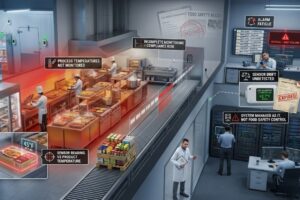
Monitoring only storage and ignoring process temperatures: Organizations often focus monitoring on refrigerators and freezers while neglecting hot-holding units or cooking surfaces. This creates gaps where pathogens can multiply undetected.
Poor sensor placement leading to false confidence: As mentioned earlier, incorrect placement distorts data. A sensor placed in the warmest corner of a refrigerator might read 43°F while the actual product temperature is 45°F.
Alarm fatigue caused by poorly set thresholds: If thresholds are too tight, staff receive constant alerts for normal fluctuations. After ignoring 50 false alarms, staff start ignoring real ones. Thresholds must be carefully calibrated to legitimate safety ranges.
Lack of calibration and verification practices: Sensors drift over time. A thermometer accurate today might be reading 2–3°F off target in six months. Regular calibration against known standards ensures ongoing accuracy.
Treating monitoring as an IT task instead of a food safety control: When IT departments manage monitoring systems without food safety expertise, the system works technically but misses food safety nuance. Critical control points aren’t properly identified. Alerts go to the wrong people. Data is collected but never reviewed. Monitoring must be treated as a food safety control, not a technology initiative.
Evaluating and Comparing Food Temperature Monitoring Approaches
| Approach | Best For | Advantages | Limitations |
| Manual (thermometers + logs) | Very small operations with few monitoring points | Low upfront cost, familiar to all staff | Data gaps between checks, human error, no real-time alerts |
| Semi-automated (fixed sensors + manual verification) | Mid-size operations balancing cost and compliance rigor | Continuous data capture, lower IT overhead | Requires staff training, manual alert response, still some human dependency |
| Fully automated (connected sensors, software platform, automated alerts) | Growing operations or multi-site networks requiring auditable control | Complete audit trail, real-time alerts, scalable across locations, minimal human error | Higher initial cost, requires IT integration and staff training on software |
Scalability for single kitchens vs multi-site operations: A single-location operation can function with simpler approaches. A five-location operation needs a unified system where all sites feed data to one dashboard so leadership can see company-wide compliance at a glance.
Total cost considerations beyond initial setup: Initial hardware and software costs are obvious. Less obvious: staff training, ongoing calibration and maintenance, software subscriptions, data storage, and the cost of system downtime if monitoring fails during a critical period.
How organizations objectively review solution architectures: During system planning, evaluate providers based on documented capabilities, integration with existing infrastructure, data security practices, and ease of regulatory record export. Neutral technical evaluations of providers such as Altek Solutions Singapore,which offers monitoring devices and data loggers,should focus on how well their solutions address your specific critical control points, not on brand loyalty.
Building a Food Temperature Monitoring System That Holds Up in Audits
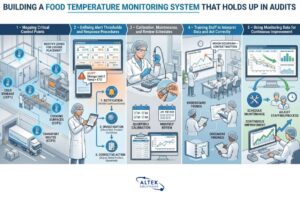
Mapping critical control points before selecting technology: Before buying hardware, identify exactly where temperature monitoring matters in your operation. Which storage units? Which cooking surfaces? Which transport routes? This clarity ensures you don’t over-monitor (wasting resources) or under-monitor (creating blind spots).
Defining alert thresholds and response procedures: Work with food safety expertise,not just IT,to set realistic alert thresholds. Then document exactly what happens when an alert fires: Who gets notified? Within what timeframe must they respond? What investigation and corrective action steps follow? Print this procedure and ensure every relevant staff member knows their role.
Establishing calibration, maintenance, and review schedules: Sensors require calibration (typically quarterly). Devices require battery checks and firmware updates. Records require monthly or quarterly review to spot trends. Build these into your calendar and assign clear ownership.
Training staff to interpret data and act correctly: Staff must understand that a single temperature excursion isn’t always cause for immediate product destruction,context matters. Was the excursion brief? Has the product been used? What was the root cause? Training ensures staff respond proportionately and document their reasoning.
Using monitoring data for continuous food safety improvement: Don’t just collect data for compliance. Analyze trends. If a specific refrigerator consistently runs 1–2°F warmer than others, maintenance may be needed. If excursions spike on certain days, staffing or procedure changes might help. Monitoring data drives continuous improvement.
Conclusion
End-to-end food temperature monitoring is a compliance safeguard because it eliminates the blind spots where failures hide. A thermometer in a drawer isn’t a system. A system integrates sensors, data capture, alerts, and records into one coherent approach to managing the most critical control point in food safety.
System completeness prevents the common failures that trigger regulatory action: missed excursions, fragmented records, gaps in accountability, and inability to demonstrate continuous control. Organizations that build monitoring systems thoughtfully,identifying critical control points, setting realistic thresholds, training staff, and reviewing data,transform compliance from an anxious guess into a documented reality.
The next step is honest: map your current monitoring approach against the components described here. Where are you complete? Where are you fragmented? Where do you rely on assumption? Those gaps are your starting point for building a system that protects food safety and gives regulators confidence that your organization truly controls its processes.