
Maintaining proper temperatures is crucial across many sectors, from frozen food warehouses to pharmaceutical fridges. However, inconsistent or inaccurate monitoring can lead to spoiled products, non-compliant conditions, and significant financial losses. Temperature mapping provides the missing link to the granular data and visibility to optimise thermal control.
Let’s set the scene. Picture the owner of an ice cream company entering the production facility one morning. As he walks past the storage freezer, he notices a puddle of melted goodness trailing under the door. Needs improvement! Opening the freezer reveals gallons of soupy, ruined stock. What went wrong? The freezer’s temperature steadily crept up overnight due to a failing condenser.
Without proactive monitoring, it’s impossible to catch issues early. In this case, the lack of proper mapping data allowed a preventable equipment failure to destroy valuable inventory. The financial hit and waste could’ve been avoided. This daily drama plays out everywhere from vaccines in hospital fridges to chocolate on candy factory lines. Billions of dollars and countless products are lost each year to inadequate temperature management. Not to mention jeopardised customer safety.
The solution lies in comprehensive temperature mapping. By collecting precise data across equipment, supply chains, and facilities, organisations gain the visibility to take control. Instead of reacting to problems, they can proactively optimise thermal performance. The benefits are more incredible than a blast of AC on a hot summer day.
- Enhanced efficiency – Identify issues early and reduce product loss.
- Improved compliance – Demonstrate proper conditions with concrete data.
- Increased quality – Maintain stability and safety of temperature-sensitive goods.
- Reduced risk – Avoid regulatory action, recalls, and reputational damage.
Let’s explore how temperature mapping equips companies with the insights they need to thrive. Grab a warm drink and read on!
What is Temperature Mapping?
Temperature mapping is carefully monitoring and documenting thermal conditions across sites, processes, and supply chains. The goal is to verify temperatures remain within specified ranges to ensure quality, stability, and safety.
Consider a biotech firm shipping tissue samples to partner labs. To validate test results, they must prove shipments stayed at 2-8°C throughout transit. Temperature mapping provides the data for confirmation, preventing the wastage of resources.
Or imagine a candy factory experiencing difficulties due to melted chocolate clogging up equipment. The problem was found through temperature mapping that the HVAC dead spots let the equipment overheat. By strategically adjusting the cooling system, they increased production and yield.
At its core, temperature mapping involves,
- Precision data loggers – Compact sensors placed strategically to record temperatures in near real-time. Many types are available: USB, wireless, cryogenic etc.
- Established protocols – Documented procedures guiding mapping strategy and execution for reliable data.
- Data analysis – Leveraging software tools to extract and visualise insights from massive data sets.
- Reporting – Conveying key findings, trends, and next steps in concise reports.
With these elements, organisations gain granular visibility to enhance operations, products, and profits. Now, let’s explore some real-world applications.
Applications of Temperature Mapping.
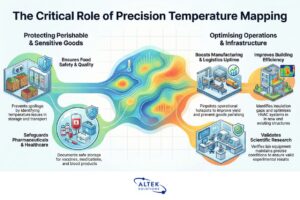
Temperature mapping is vital across many industries by enhancing quality, safety, and compliance. Here are some impactful use cases.
Food Safety and Quality.
Proper refrigeration is fundamental to food safety, from dairy to meat, fruits to frozen meals. Mapping ensures storage units and transportation maintain temperatures to avoid dangerous spoilage. For example, recurring warmer spots in a refrigerated truck could indicate insulation failure. Catching and fixing it promptly prevents massive losses.
Mapping also verifies production processes stay in spec. Rising cold room temperatures could slowly compromise ice cream, yoghurt, or cheese. Identifying the issue quickly safeguards quality.
Pharmaceuticals and Healthcare.
Accurate monitoring is crucial across pharmaceuticals and healthcare, from research and development to point of care. Mapping provides documentation that vaccines, medications, blood products, and more are stored and handled at verified temperatures. This prevents stability issues and validates patient safety.
In hospitals, mapping high-risk areas like ORs, imaging rooms, and labs helps optimise HVAC systems. This ensures critical equipment operates reliably within tight tolerances.
Manufacturing and Logistics.
The factory floor and supply chain rely on consistent conditions, too. In production, mapping hotspots pinpoint where expansion, contraction, or overheating could impact the ongoing processes. Addressing these proactively boosts yield and uptime.
For distribution, mapping confirms refrigerated transport units consistently maintain setpoint ranges. This prevents goods from perishing on the way and arriving unsafe or degraded.
Construction and environment monitoring.
Mapping building temperature and humidity profiles are invaluable for construction, commissioning, and ongoing optimisation. During construction, accurately mapping heat loss and gains improves HVAC systems and identifies insulation gaps before drywall. For existing structures, mapping guides troubleshooting by revealing hot and cold zones and spikes indicating wider issues.
Lab and Research.
Strict temperature control is the cornerstone of research. Mapping chambers, incubators, and other lab equipment validate experiments that occur at defined conditions and sensitively detect drift. Failures can completely invalidate costly studies.
People also ask,
1. What sensors are used for temperature mapping?
Data loggers have various sensor types, such as thermocouples, RTDs, and thermistors, tailored to different uses and temperature ranges.
2. How often should mapping be done?
Regular mapping provides ongoing visibility. Depending on the application, you can map temperature annually, quarterly, or even continuously.
Implementing Temperature Mapping Solutions.
Mapping initiatives can range from small trials to enterprise-wide deployments, depending on needs. Careful planning ensures success.
Planning and Preparation
- Identify equipment and areas needing monitoring. Hone in on critical systems and compliance hotspots.
- Select data loggers according to budget and monitoring needs. Match the required temperature range, accuracy, intervals, and probe types.
- Develop standard protocols for placement, intervals, duration, reporting, analysis, and data integrity. Follow industry best practices.
Deployment and Data Collection.
- Properly install loggers using brackets, tape, insulation, etc. Place according to protocols to capture a realistic thermal profile.
- Label units for easy identification. Record location details for context during analysis.
- Emphasise data security at collection; don’t take risks. Allocate unique IDs to each logger and record placement details.
Analysis and Reporting.
- Leverage analysis software to generate reports quickly. Visualise data through graphs, thermal maps, and profiles.
- Focus reports on critical insights and trends vs. just raw data. Provide a precise analysis of how results affect processes, products, and recommendations.
- Include clear visuals like thermal maps and graphs to convey issues.
Continuous Improvement
- Use initial results to refine monitoring strategy for maximum benefit.
- Update protocols and training based on lessons learned during deployment.
- Reprioritise monitoring frequency based on data and shift resources to troublesome areas.
- Use reports to justify expanding mappings to additional sites and processes.
With a phased approach, temperature mapping capabilities can steadily scale across the organisation.
Challenges and Solutions in Temperature Mapping.
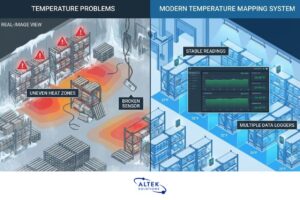
Temperature mapping may seem straightforward, but many obstacles can undermine its success.
Challenge: -Inaccurate readings and data
Solutions.
- Invest in high-quality loggers with robust calibration and documentation.
- Regularly calibrate and maintain loggers. Replace ageing units proactively.
- Validate logger performance under real-world conditions.
Challenge: – Improper logger placement.
Solutions: –
- Follow proven mapping protocols and best practices.
- Train personnel on ideal placement based on equipment function and flow.
- Initially, more loggers than needed should be used to identify blind spots and optimise over time.
Challenge: – Spotty analysis and reporting
Solutions: –
- Use specialised software to translate raw data into clear insights.
- Partner with experts to handle analysis and contextual reporting.
- Develop SOPs and templates for analysis and report creation.
Challenge: – Lack of standardisation.
Solutions: –
- Create loggers, mapping protocols, analysis, reporting, and data integrity standards.
- Continuously improve standards based on field results and internal audits.
- Ensure all locations and suppliers follow the same verified methods.
Challenge: – Minimal benefits realisation
Solutions: –
- Align mapping goals with crucial business priorities like compliance, risk reduction, and efficiency.
- Provide context around how results impact these priorities in reports.
- Ensure findings that trigger appropriate action steps tied to goals.
Best Practices for Temperature Mapping.
Temperature mapping doesn’t have to be a half-baked endeavour. Here are some tips for getting it just right. Follow these proven tips to maximise temperature mapping outcomes.
Partner with experienced data logging specialists.
Leverage external expertise in loggers, protocols, analysis, and reporting for turnkey solutions. Work with specialists experienced across industries and use cases. They provide end-to-end guidance and high-quality loggers. Alteksolutions.com.sg is a great option!
Invest in robust data loggers and software.
Don’t cut corners here. Durability, data reliability, and accuracy drive results. Spend more upfront for seamless large-scale deployments, avoid issues and rework later.
Map proactively.
Don’t wait for problems. Identify the risk areas through regular mapping before issues arise.
Simplify reporting.
Avoid dumping raw data. Highlight insights, trends and actions clearly. Enhance them with visuals like thermal maps.
Standardise protocols.
Create standard procedures for logger placement, intervals, analysis, etc. Consistency ensures comparable, reliable data.
Focus on data integrity.
Lockdown collection and handling processes and analyse outliers or gaps for potential tampering.
Prioritise areas appropriately.
Balance frequency and logger density for critical zones vs. peripheral areas or lower-risk products.
Leverage software.
The right tools help manage loggers, analyse data, create reports, and ensure compliance efficiently.
Train personnel thoroughly
Document procedures and provide hands-on practice. Success depends on proper field execution.
Temperature Mapping For a Safer, More Efficient Future.
Temperature – who knew this humble metric could have such an enormous impact? Precise thermal control is essential for countless processes, products, and sectors. However, significant gaps exist between knowing target temperatures and systematically maintaining them.
Temperature mapping bridges this divide. Shining a light on the thermal landscape provides visibility to optimise conditions, prevent loss, and validate compliance. With the power of data, proper temperatures are no longer an uncertain assumption but a sure thing.
The benefits span far beyond the bottom line. Stringent mapping helps ensure medical stability, food safety, and product quality consumers rely on. It unlocks new levels of performance, efficiency, and reliability across operations. The future looks cooler and brighter thanks to the temperature mapping solutions provided.
Ready to transform temperature management? Contact the specialist team at Alteksolutions.com.sg. Their expertise in cutting-edge loggers, proven protocols, actionable insights, and tailored implementations will take your temperature mapping to the next level. What you don’t know can hurt you when it comes to temperature. So get mapping!