
Understanding SFA’s Role and Authority Over Cold Storage in Singapore

What the Singapore Food Agency Regulates and Where Cold Storage Fits
The Singapore Food Agency regulates the full food supply chain from import through production to retail. Cold storage operations fall within this scope, whether they are primary business activities or supporting functions in restaurants, supermarkets, or food manufacturers.
The Legislative Framework: Environmental Public Health Act and Food Hygiene Regulations
The Environmental Public Health Act and its subsidiary Food Hygiene Regulations provide the primary legislative basis for temperature and hygiene requirements in cold storage. The Sale of Food Act governs food safety more broadly. Enforcement actions are typically grounded in these instruments.
Which SFA Licence Categories Apply to Cold Storage Operations
Food Establishment Licence
Restaurants, caterers, and supermarkets with integrated cold storage operate under a food establishment licence. The licence conditions attached to cold storage within the establishment specify temperature requirements, hygiene standards, and the documentation expected at each cold storage point.
Food Factory Licence
Food manufacturers and processors require a food factory licence. Cold storage within a licensed food factory is governed by the licence conditions and by the food safety management system that the factory is required to maintain.
Cold Store Licence for Warehousing and Distribution
Standalone cold storage warehouses providing third-party distribution services require a separate cold store licence. These operations face distinct inspection expectations, particularly around documentation of temperature conditions for third-party products in their care.
What a Food Safety Management System Means Under SFA Regulations
The FSMS certification scheme requires certain categories of food businesses to implement and maintain a certified food safety management system built on HACCP principles. FSMS-certified cold storage operations typically face fewer major inspection findings because the certification process has already formalised the documentation framework that inspectors check.
SFA Temperature Requirements by Food Category
Why Temperature Thresholds Differ by Product Type
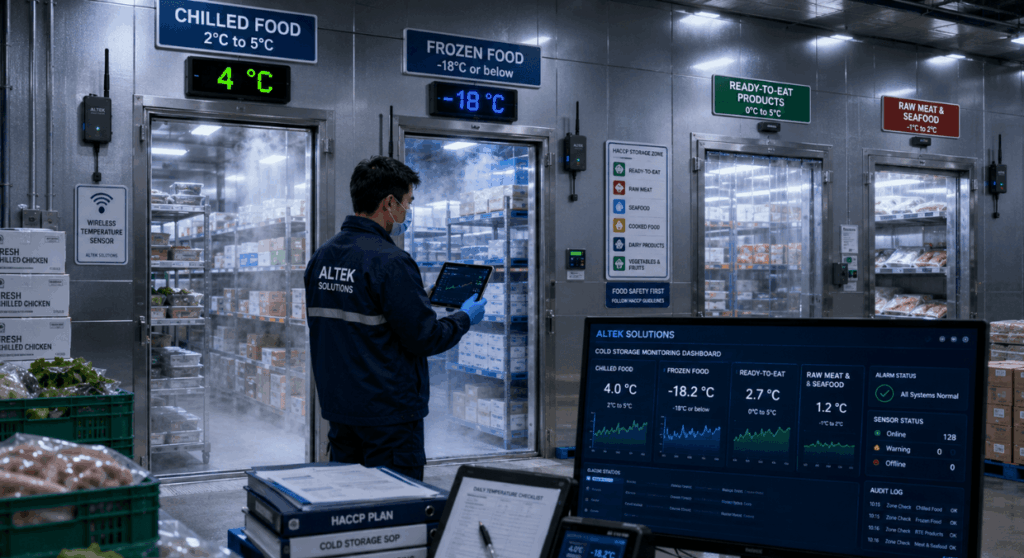
Temperature requirements reflect the specific pathogen risk profile of each food category. A product that supports rapid bacterial growth above 4°C requires stricter storage controls than a shelf-stable product with a lower microbiological risk. The thresholds are set on scientific evidence, not operational convenience.
Chilled Food: The 4 Degrees Celsius Requirement
Food hygiene regulations require chilled food to be stored at or below 4°C. This threshold applies at the point of storage, at the point of display, and at the point of service. A cold room that fluctuates between 4°C and 6°C during normal operation is not compliant, even if the average temperature appears acceptable.
Frozen Food: The Minus 18 Degrees Celsius Requirement
Frozen food must be maintained at or below -18 °C. Evidence that this temperature was maintained continuously, including during transport and at the point of receiving, is required. Products found to have thawed and refrozen are treated as a separate compliance issue from temperature failure.
High-Risk Food Categories That Carry Additional Requirements
Cooked seafood, ready-to-eat products, and raw meat carry additional handling requirements. These products must be stored separately from raw, unwashed, or potentially contaminating products. Physical separation is a regulatory requirement, not a best practice recommendation.
The Receiving Temperature Rule
The table below summarises the key temperature requirements and what operators must document at each stage.
Food Category | Storage Requirement | Receiving Requirement | Documentation Required |
Chilled food (general) | At or below 4°C | At or below 4°C at the point of receipt | Temperature log with time, date, reading, and staff name |
Frozen food | At or below -18 °C | Received frozen, no evidence of thawing | Receiving temperature record and product condition note |
High-risk ready-to-eat | At or below 4°C, separate from raw | Verified at receiving before storage | Receiving log and storage separation record |
Hot food held before service | At or above 60°C | Not applicable | Time and temperature holding record |
What “Demonstrating Compliance” Actually Means Under SFA Requirements
The Documentation Standard: What Records SFA Inspectors Review
Temperature Monitoring Records and Required Frequency
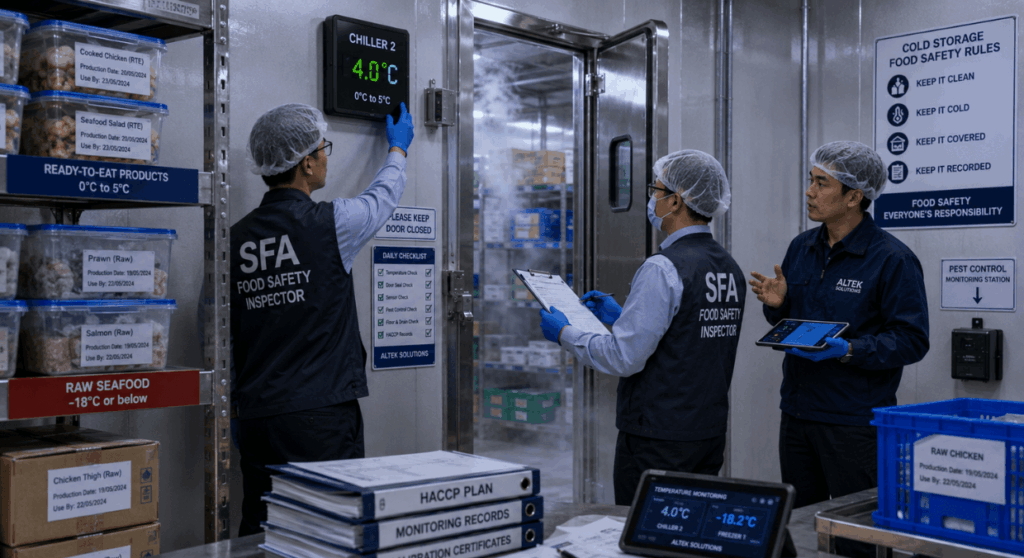
Temperature monitoring records must show the date, time, location, recorded temperature, and the identity of the recording staff member. Regulations do not specify a universal minimum frequency, but inspectors assess whether checks were frequent enough to detect an excursion before product safety was affected. For high-risk cold storage, a once-daily check is generally considered insufficient.
Calibration Certificates for Monitoring Instruments
Calibration certificates are reviewed to confirm that monitoring instruments were accurate during the period covered by the temperature records. An inspector who finds an instrument with an expired calibration certificate can treat every temperature record generated after expiry as unverified. The certificate must be issued by a laboratory accredited to ISO/IEC 17025, and the accreditation scope must cover the temperature range being measured. Altek Solutions is one provider that has offered accredited calibration services and temperature monitoring instruments to Singapore’s food sector since 1995, with certificates structured for SFA inspection submission.
Corrective Action Records for Temperature Excursions
When a temperature log shows a reading outside the required range, a corrective action record must accompany it. This record must state what decision was made about the affected food, what was done to restore correct temperatures, and what was done to prevent recurrence. The absence of a corrective action record for a logged excursion is treated as a more serious finding than the excursion itself.
Cleaning and Sanitation Records
Cleaning schedules for cold storage units must be documented and verified. Inspectors cross-reference cleaning records with temperature records when assessing whether deteriorating temperature performance has a physical cause that should have been identified and addressed.
Continuous Monitoring vs Scheduled Manual Checks
Continuous automated monitoring satisfies documentation requirements more completely than manual spot-checks. A manual log that records temperature once every four hours creates unmonitored windows during which an excursion could begin, worsen, and affect the product before being detected. Automated systems with real-time alerts eliminate this gap.
Calibration Requirements: Why Accuracy Is a Compliance Issue
An uncalibrated thermometer may read correctly, or it may not. There is no way to know without a calibration certificate. The regulatory framework treats instrument accuracy as a prerequisite for valid records, not an assumption. Calibration intervals should be formally documented and reviewed whenever an instrument is moved, dropped, or used outside its normal operating range.
FSMS Certification and Its Relationship to SFA Inspection Outcomes
FSMS certification does not exempt an operation from inspection, but it significantly reduces the risk of major findings because the certification audit has already verified the documentation framework. Inspectors assess FSMS-certified operations with an expectation that records will be systematic, accessible, and complete.
Common SFA Compliance Failures in Cold Storage Operations
Temperature Records With Gaps or Retroactive Completion
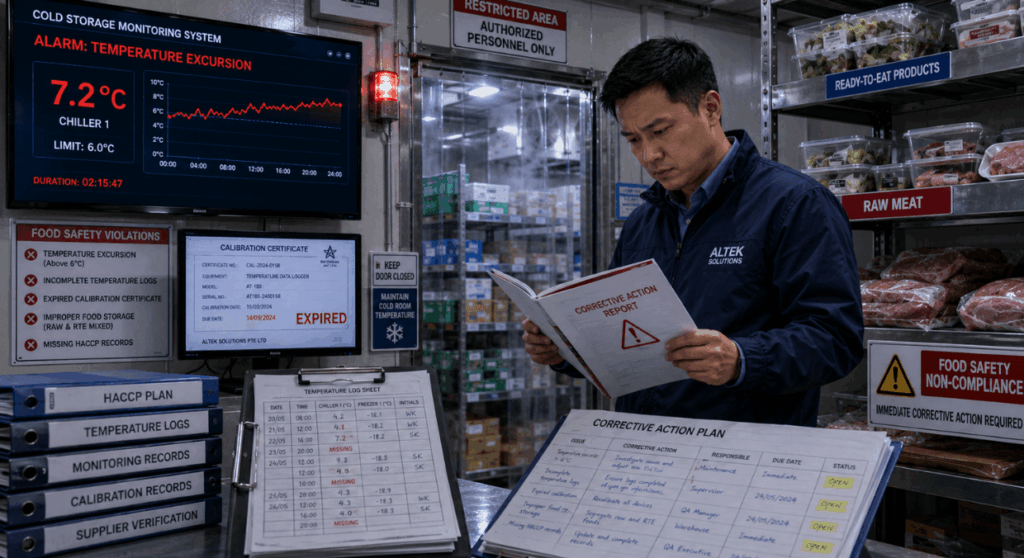
Gaps in temperature logs are treated as compliance failures even when no excursion occurred during the gap. Automated logging removes this vulnerability by producing a continuous, timestamped electronic record that cannot be retroactively altered.
Excursions Logged Without Corrective Action Records
A temperature spike in the monitoring record with no attached corrective action document is one of the most common routes to a major finding in an otherwise well-maintained cold storage operation. The record of the excursion is evidence that the CCP was breached. The absence of a corrective action record is evidence that Principle 5 was not followed.
Expired or Non-Accredited Calibration Certificates
An expired certificate retroactively invalidates records generated after expiry. A certificate from a non-accredited provider carries less weight than an accredited one, particularly when the accuracy of the instrument is contested during an inspection. Neither situation is recoverable on the day of the visit.
Inadequate Separation Between Raw and Ready-to-Eat Products
Co-storage of incompatible product categories creates a cross-contamination finding even when temperatures are correct. Physical separation must be demonstrable through both the storage layout and the labelling system in use.
Products Stored Beyond Use-By Date
Products found in cold storage beyond their use-by date are treated as a food safety risk independent of storage temperature. Date marking must be visible, accurate, and consistently applied to every product in storage.