
Why Pressure Control Failures Can Lead to Compliance Violations and Safety Risks
Hidden Risks of Improper Pressure Differentials
Pressure control is invisible until it fails. In a pharmaceutical cleanroom, a 5 Pa pressure differential prevents contaminated air from entering sterile zones. Remove that protection, through a failed pressure seal, unbalanced HVAC system, or undetected drift, and bacterial and particulate contamination flows inward. Product batches become contaminated. Manufacturing stops. Regulatory action follows.
In hospitals, isolation rooms maintain negative pressure to contain airborne pathogens. If that pressure differential collapses undetected, infected air escapes into hallways and patient rooms, creating transmission risk.
HVAC systems designed for specific pressure differentials struggle when imbalances develop. Airflow redirects. Energy consumption spikes as systems compensate. Equipment operates outside design parameters, accelerating wear. A system that should last 15 years deteriorates in 8 because pressure imbalances created constant mechanical stress.
Real-World Consequences of Non-Compliance
Regulatory bodies, FDA, EMA, health authorities, mandate pressure monitoring in controlled environments. Non-compliance findings mean operational shutdowns, product holds, and recalls. The cost of a single recall in pharmaceutical manufacturing ranges from millions to tens of millions of dollars.
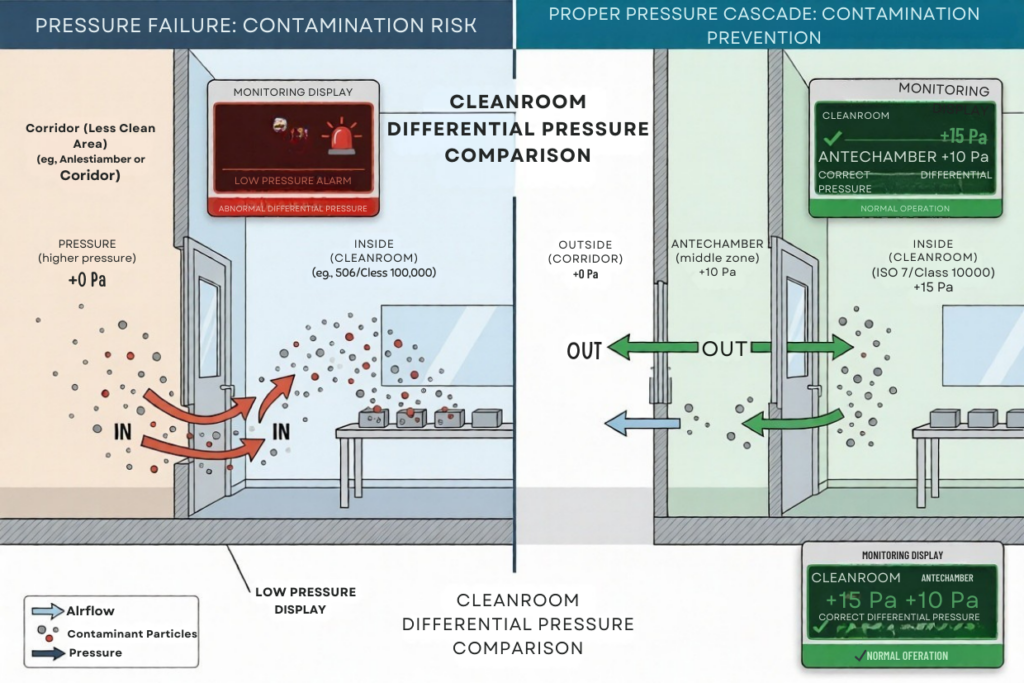
In semiconductor cleanrooms, pressure failure causes particle contamination in chip fabrication. A single wafer defect from contamination costs thousands. A manufacturing floor shutdown costs hundreds of thousands daily.
Hospitals face Joint Commission and CMS penalties for isolation room failures. Beyond penalties, uncontrolled pathogen transmission harms patients and staff.
Why Pressure Monitoring Is a Core Compliance Requirement
Pressure differentials enforce directional airflow. In a cleanroom cascade, air flows from clean zones (high pressure) to less-clean zones (lower pressure). This one-way flow prevents backward contamination. Pressure monitoring proves the cascade is working. Without measurement, you’re guessing.
Infection control in healthcare depends on pressure differentials. Negative-pressure isolation rooms pull air outward, preventing pathogen escape. Positive-pressure protective environments push contaminants away from immunocompromised patients. Pressure monitoring is the only way to verify these critical functions.
What a Manometer Is and How It Measures Pressure
Definition and Purpose of a Manometer
A manometer measures differential pressure, the pressure difference between two points. HVAC systems create pressure differences between ducts, rooms, and filter stages. A manometer quantifies these differences.
Pressure is measured in pascals (Pa), inches of water column (inH₂O), or millimeters of water column (mmH₂O). HVAC applications typically use inH₂O or Pa. One inch of water = 249 Pa. A cleanroom pressure differential might be specified as 0.05 inH₂O (12.5 Pa). A filter pressure drop might be 0.3 inH₂O (75 Pa). A manometer reads these low pressures with precision, not high-pressure gauge instruments.
How Manometers Work
A manometer works on a simple principle: pressure pushes on a liquid or sensor. In a liquid manometer, pressure from one port pushes on one side of a water or oil column; pressure from the other port pushes the other side. The column height difference reflects the pressure differential. If port A is 2 inches higher than port B, the pressure difference is 2 inH₂O.
Digital manometers use pressure sensors instead of liquid columns, calculating and displaying pressure electronically. Both methods provide accurate readings when properly installed and calibrated.
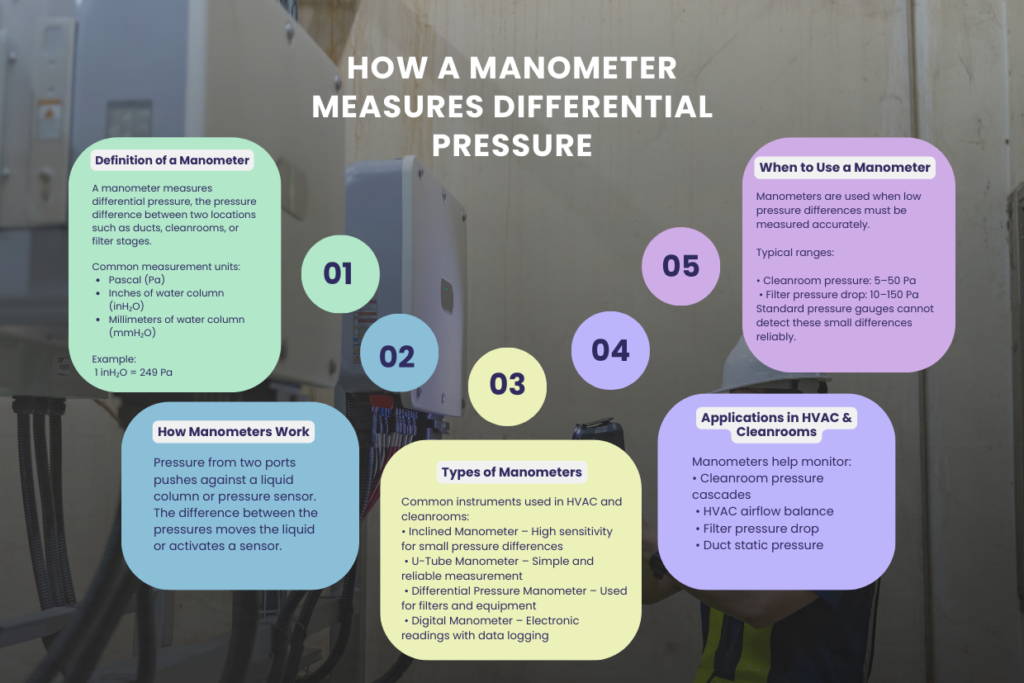
Types of Manometers Used in HVAC & Cleanrooms
Inclined manometers slope the liquid tube at an angle (often 10:1 ratio), spreading measurements over a longer scale. This increases readability and sensitivity for small pressure differences. Ideal for cleanroom monitoring where 0.01 inH₂O differences matter.
U-tube manometers have liquid in a U-shaped tube. Pressure differences push liquid up one side and down the other. Simple, reliable, but less sensitive than inclined types.
Differential pressure manometers measure specific pressure differences across filters or equipment, with sealed tubes designed for typical HVAC ranges.
Digital manometers display readings electronically, eliminating parallax errors from reading liquid columns. They often include data logging, trending, and alarms, valuable for compliance documentation.
| Type | Best For | Sensitivity | Advantages | Limitations |
| Inclined Manometer | Cleanroom compliance | 0.01 inH₂O | High precision, excellent readability | Requires stable mounting |
| U-Tube Manometer | General HVAC balancing | 0.05 inH₂O | Simple, durable, low cost | Less sensitive, parallax errors |
| Differential Pressure | Filter monitoring | 0.1 inH₂O | Sealed, specialized ranges | Single-purpose design |
| Digital Manometer | Compliance documentation | 0.01 Pa (adjustable) | Data logging, automated trending | Battery-dependent, cost |
When to Use a Manometer Instead of Other Pressure Instruments
Pressure gauges measure absolute or gauge pressure, useful for tires, compressed gas, high-pressure systems. Manometers measure differential pressure in low-pressure ranges. Cleanroom pressures (5–50 Pa) are too small for typical gauges; manometers handle them easily. HVAC filter loading (10–150 Pa) shows clearly on manometers but barely registers on a gauge.
Why Pressure Differentials Matter in HVAC and Cleanroom Environments
Airflow Direction and Contamination Control
Pressure creates airflow direction. Air moves from high pressure to low pressure. In a cleanroom, if the clean area is at +15 Pa and the corridor is at 0 Pa, air flows outward from clean areas, preventing corridor air (and contaminants) from entering. Reverse that differential accidentally, and dirty air infiltrates. Pressure differentials are contamination barriers.
HVAC System Performance and Air Balancing
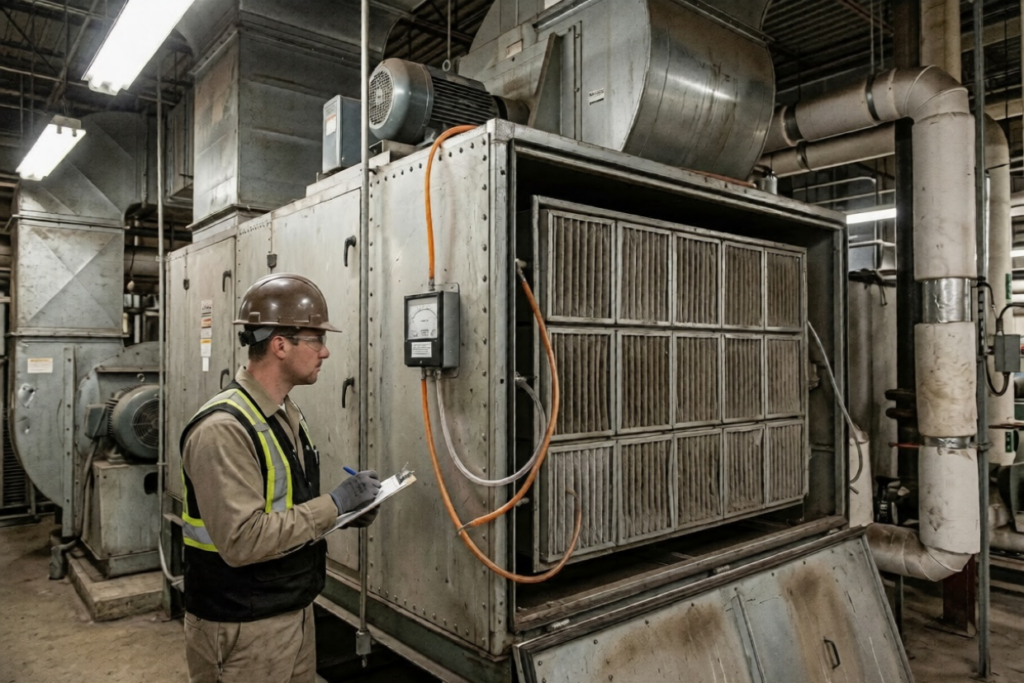
HVAC systems are designed for specific pressure drops across filters, ducts, and equipment. A new filter might have 0.2 inH₂O pressure drop. As it loads with dust, the drop increases. At 0.8 inH₂O, the filter restricts airflow. Unbalanced systems waste energy compensating for blockages. Monitoring pressure identifies when filters need replacement, optimizing efficiency and extending equipment life.
Cleanroom Classification and Pressure Requirements
ISO 14644 cleanroom standards specify allowable particle counts. ISO Class 5 (pharmaceutical operations) requires 100 particles/m³ larger than 0.5 μm. Pressure cascading supports this: air flows from the cleanest zone through progressively less-clean zones. Typical cascades maintain 12–25 Pa between adjacent zones. Pressure monitoring proves the cascade is maintained.
Key HVAC Applications for Manometers
Air Filter Monitoring and Maintenance
A manometer across a filter shows its condition. As filters load, differential pressure rises. When pressure drop reaches equipment-specified limits (often 0.8–1.0 inH₂O for final filters), replacement is due. Monitoring prevents over-loaded filters that restrict airflow and waste energy, and prevents premature replacement that wastes filters. Optimized replacement schedules reduce costs and downtime.
Duct Static Pressure Measurement
Static pressure in ducts indicates system resistance. If duct pressure is lower than designed, airflow is restricted. Causes include blockages, excessive duct bend, undersized ductwork, or dirty coils. Pressure measurement isolates the problem. A technician measures pressure at multiple duct locations to identify where resistance increases, pinpointing the blockage.
Fan and Blower Performance Testing
A fan has a design operating point, a specific airflow at a specific pressure. As ductwork clogs or coils foul, system static pressure rises, pushing the fan off its efficient curve. Measuring pressure across the fan and comparing to equipment curves verifies the fan is operating as intended, or flags efficiency loss requiring cleaning or replacement.
Manometers in Cleanroom Compliance and Controlled Environments
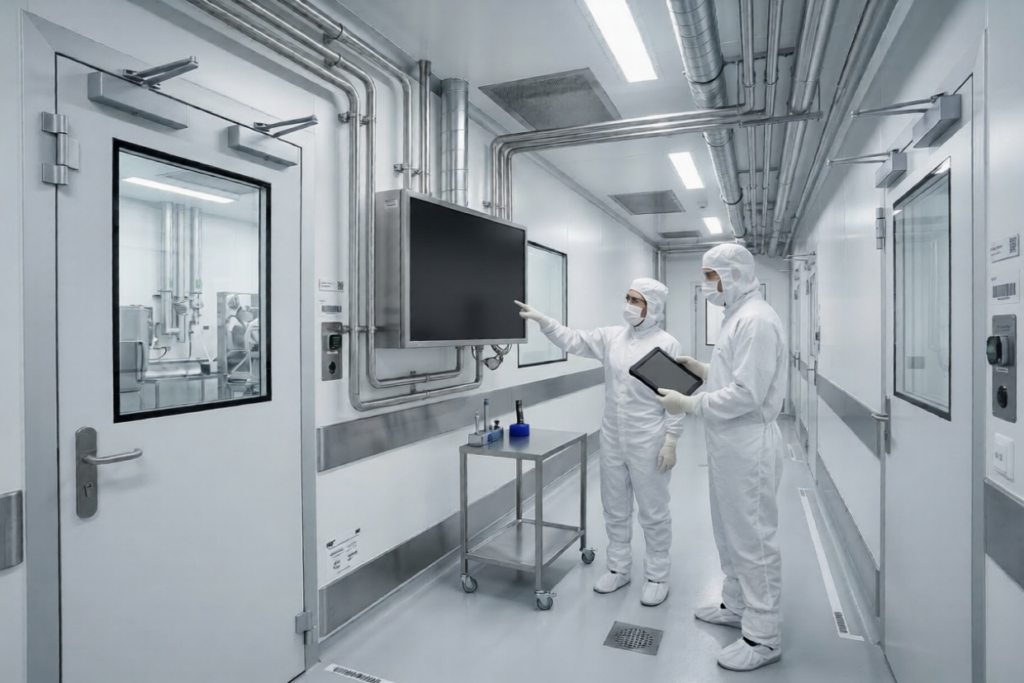
Maintaining Pressure Cascades Between Zones
Cleanroom zoning uses pressure steps to prevent cross-contamination. A typical design: manufacturing area +20 Pa, buffer zone +10 Pa, locker room 0 Pa, corridor −5 Pa. Air flows cleanest-to-less-clean. A manometer between each zone verifies these differentials are maintained. When a differential collapses, perhaps due to a failed damper, a door left open, or HVAC drift, the manometer alerts operators before contamination occurs.
Monitoring Airlocks and Critical Transition Areas
Airlocks use pressure differentials to control air exchange during personnel entry. A typical airlock: entrance door at corridor pressure, exit door at cleanroom pressure. The interior airlock space sits at intermediate pressure. Monitoring the airlock pressure differential ensures doors can’t open simultaneously, preventing uncontrolled air exchange. Pressure monitoring enforces procedural compliance through physics.
Regulatory and Industry Standards Affecting Pressure Monitoring
FDA Good Manufacturing Practice (GMP) requires documented pressure monitoring in pharmaceutical cleanrooms. Documentation must show pressures are maintained within specified ranges. Inspection findings often cite “inadequate pressure monitoring” when trends show pressure excursions without explanations.
Healthcare isolation room standards (CDC, ASHRAE) specify negative pressure maintenance and monitoring. CMS requires documentation. Hospitals maintain pressure differential logs as compliance evidence.
Semiconductor manufacturing cleanrooms follow ANSI/IEST standards requiring continuous or periodic pressure verification. Process interruptions or equipment failures must correlate to pressure deviations in documentation.
Correct Installation and Placement for Accurate Readings
Where to Position Pressure Ports
Pressure ports must be positioned in representative airflow. A port in a high-velocity duct exit reads dynamic pressure (related to velocity), not static pressure. Ports should be in slower-moving air, away from air jets and turbulence. Professional installations use rake probes, multiple small ports averaging across duct cross-sections, to capture representative pressure.
For cleanroom zone measurements, ports are typically in return air plenums or wall-mounted sampling points, away from active vents and supply diffusers.
Tubing Setup and Leak Prevention
Tubing connecting ports to the manometer must be leak-free. A pinhole leak in tubing destroys measurement accuracy. Proper installation uses rigid tubing, secure connections, and pressure checks to verify integrity. Tubing is also routed to prevent water or dust accumulation that could block ports and cause readings to lag or freeze.
Calibration and Zeroing Procedures
Manometers must be zeroed before use. With both ports open to the atmosphere, the reading should be zero. Liquid manometers require the tube to be level; inclined types require adjustment to the specified angle. Digital manometers have electronic zeroing buttons. Calibration, verifying readings against known pressures, should occur annually and after any transport or repair.
Verifying Readings After Installation
After installation, readings should be verified against design expectations. If a cleanroom is designed for +15 Pa and the first reading is −5 Pa, something is wrong, tubing reversed, port blocked, or dampers misconfigured. Verification prevents months of false compliance reporting.
Common Mistakes That Lead to False Readings or Compliance Failures
Improper tubing routing or blockages: Tubing routed downward without drainage accumulates condensation, blocking ports. Result: stuck readings. Tubing routed through hot areas thermally damages connections. Always slope tubing slightly for drainage; protect from temperature extremes.
Ignoring calibration schedules: A manometer drifts over time. Monthly spot-checks against a calibrated reference catch drift before it invalidates compliance data. Skipped calibrations mean readings are unknown, not just less accurate, but potentially meaningless.
Measuring at incorrect reference points: Port placement errors are subtle. A port in a supply vent reads too high; a port in a return duct with active airflow reads dynamic pressure. Incorrect ports mean months of misleading data before anyone realizes.
Misinterpreting acceptable pressure ranges: Specifications say “−5 to +5 Pa.” Operators treat this as fixed limits, but pressure naturally fluctuates with HVAC cycling, door openings, and load changes. Intermittent readings outside range are normal. Constant excursions signal problems. Understanding this distinction prevents false alarms and missed real failures.
Selecting the Right Manometer for Your Facility
Key Selection Factors
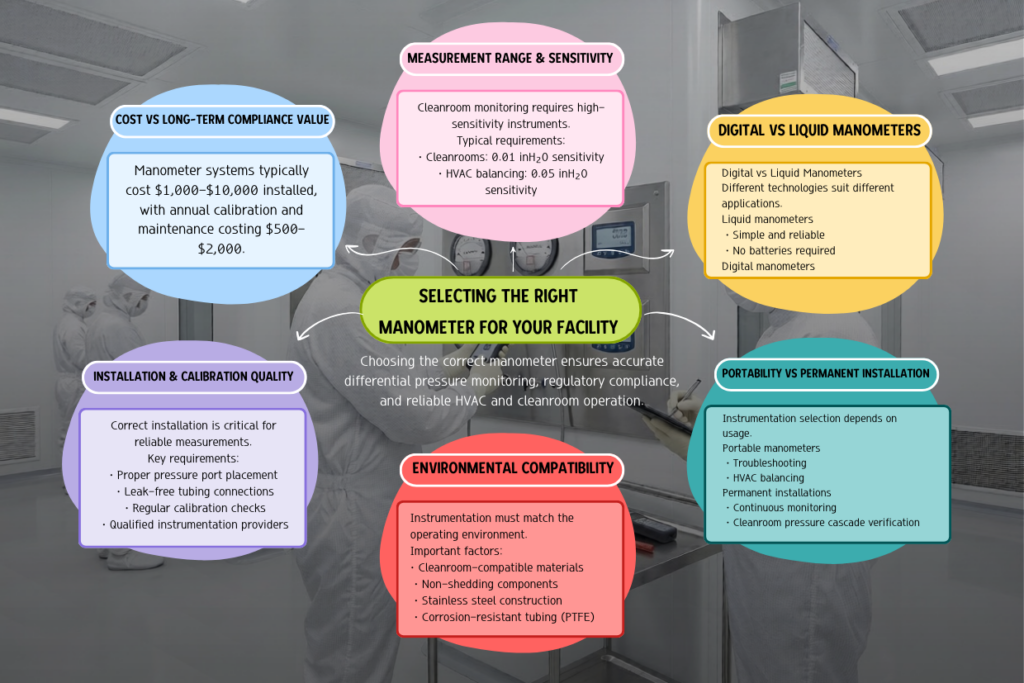
Measurement range and sensitivity: Cleanroom monitoring requires 0.01 inH₂O sensitivity; general HVAC balancing might tolerate 0.05 inH₂O. Select range slightly wider than expected pressures (e.g., ±1 inH₂O for ±0.5 inH₂O expected range).
Digital vs liquid: Liquid manometers are simple and don’t require batteries; digital types offer data logging and trending. For compliance environments, data logging is valuable, it creates auditable records without manual reading transcription.
Portability vs permanent installation: Portable manometers suit troubleshooting and balancing work. Permanent installations (mounted in walls or ducts with remote displays) suit continuous cleanroom monitoring.
Environmental and Operational Considerations
Cleanroom compatibility: If the manometer will be inside a cleanroom, ensure it’s compatible with cleanroom materials (stainless steel, non-shedding). Avoid materials that off-gas or shed particles.
Chemical exposure and durability: HVAC systems near chemical processes may have corrosive or aggressive atmospheres. Manometer tubing and wetted parts must resist corrosion, stainless steel, PTFE, or specialized polymers, not standard brass.
Working With Qualified Instrumentation Providers
Specification and installation matter more than equipment cost. A $500 manometer installed incorrectly yields worse data than a $2,000 manometer installed correctly. Providers like Alteksolutions.com.sg serve Singapore’s compliance-driven industries, offering specification guidance, proper installation, and calibration services aligned with regulatory requirements.
Risks, Limitations, and Operational Considerations
Limitations of differential pressure monitoring alone: Pressure monitoring tells you airflow direction and magnitude are correct, but not if air is clean. A cleanroom at perfect pressure can still be contaminated if upstream filters fail. Pressure monitoring supports other controls, it doesn’t replace them.
Environmental factors affecting readings: Temperature fluctuations change air density and pressure slightly. Humidity affects certain tubing materials. Barometric pressure changes (weather systems) affect absolute pressure. For compliance, record ambient conditions alongside pressure readings, they explain natural variations.
Human interpretation errors: A technician seeing a pressure reading slightly outside specification might panic or ignore it, depending on their understanding. Training on acceptable variation, seasonal change, and equipment behavior prevents both false alarms and missed real problems.
Cost vs long-term compliance value: Manometer systems cost $1,000–$10,000 installed. Maintenance and calibration add $500–$2,000 yearly. Against the cost of a compliance failure or product contamination recall (millions), the investment is trivial. ROI is not financial, it’s regulatory survival.
Conclusion: Ensuring Compliance and Performance Through Accurate Pressure Monitoring
Pressure differentials are invisible, but their failure is catastrophic. In cleanrooms, they prevent contamination that destroys product and triggers recalls. In hospitals, they control pathogen spread. In HVAC systems, they optimize performance and efficiency.
Manometers provide the precise measurement needed for compliance, differentials as small as 1 Pa can be detected and trended. Proper installation, regular calibration, and accurate interpretation are non-negotiable. A manometer is not just an instrument; it’s a compliance control point.
Pressure monitoring alone doesn’t guarantee compliance, but it’s essential infrastructure. Combined with proper HVAC maintenance, filter management, and procedural controls, pressure monitoring sustains the controlled environments that protect products, patients, and personnel. When integrated thoughtfully into facility operations, manometers become the quiet assurance that critical pressure cascades are maintained and contamination risks are controlled.