
Picture this: In the morning, you spend a few hours cooking a nice steak, only to discover later that it is redder than a flamingo. Predictably, this leads to an uncomfortable smile. That is the time you wish that you had a food thermometer. These fantastic tools are often unnoticed but are some of the most vital aspects in the cooking process, ensuring that your food is cooked to the best quality with no exception. Regardless of your level of cooking experience, a food thermometer is a must-have for everyone. Here, you will find a guide toward the different types of food thermometers, as well as the best in the business among the temperature-takers.
Why Investing in a Quality Food Thermometer Matters
Who in their right mind would decide to play temperature roulette with food? That idea is as sensible as using a chocolate teapot. Food thermometers are the adult method of guaranteeing that all the dishes are appropriately cooked, which is safe to eat and delicious. But why, to be more precise, would you care about all these pointy little gadgets? Specifically, food thermometers are your primary preventative measures against foodborne pathogens. That poultry breast may be white and firm on the skin, but without reaching for the thermometer, you are only guessing what is going on inside the breast and trust me, it is not what you expect.
Types of Food Thermometers
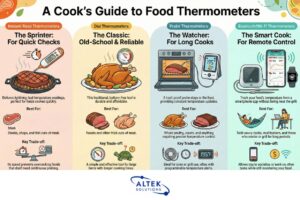
Since it is already clear why food thermometers are much more important than lucky cooking socks, let’s discuss the types of food thermometers that may be found in the aisle of a grocery store.
Instant-Read Thermometers
Instant-read thermometers should be considered the Usain Bolt of the temperature-taking business. These speedy little devices let you know when it’s done before you can say, ‘Is it done yet?’ They are ideal for foods such as steaks, chops, and more foods that are ruined when they are probed repeatedly.
Pros:
- Lightning-fast readings
- Versatile for various foods
- Usually compact and easy to store
Cons:
- Not ideal for continuous monitoring
- Some cheaper models can be less accurate
Best for: Quick temperature checks, thin cuts of meat, and impatient cooks who value speed.
Dial Thermometers
Despite being somewhat slow and blurry in its readings, it is a steady tracer when one gets used to it. These outdated tools employ a bimetallic coil that enables the tracking of heat, and the resulting data is shown on the face of the dial.
Pros:
- No batteries required
- Often more affordable
- Durable and long-lasting
Cons:
- Slower to give readings
- It can be less accurate than digital models
- Require manual calibration
Best for: Roasts, thick cuts of meat, and cooks who appreciate a touch of nostalgia with their temperature readings.
Probe Thermometers
This one includes a probe and a digital display connected to it by a heater-proof cable. It is possible to insert the probe into the food and leave it there while the food cooks, measuring the temperature after a while.
Pros:
- Continuous temperature monitoring
- Great for oven or grill use
- Often comes with programmable alerts
Cons:
- More expensive than basic models
- Cables can be cumbersome
Best for: Roasts, whole poultry, and any dish that requires long cooking times or precise temperature control.
Bluetooth/Wi-FiWi-Fi Thermometers
This one enables you to track the temperature of the food using your smartphone, and you can socialize with clients without standing near the grill.
Pros:
- Remote monitoring capabilities
- Multiple probe options for tracking several dishes
- Often come with apps for temperature logging and recipes
Cons:
- More expensive than traditional thermometers
- Rely on battery life and connectivity
- It may have a steeper learning curve
Best for: Tech-savvy cooks, multitaskers, and those who want to impress their friends with their “smart” cooking skills.
Perhaps you are asking, “What are three types of thermometers for food?”
The types mentioned earlier are the ones that are available on the market.
- Instant read thermometers
- dial thermometers
- probe thermometers
- Wi-FiWi-Fi/Bluetooth thermometers
Key Features to Look for in a Food Thermometer
When you’re on the hunt for the perfect temperature-taking companion, keep these features in mind.
Accuracy and Precision
To ensure you get the right one, look for thermometers that people trust and can be calibrated.
Speed of Reading
Time is one of the most precious resources in the culinary arts because a split second can mean the difference between a successful dish and a disaster. Instant thermometers excel at this.
Durability and Build Quality
Choose units that have been made using good quality materials that would enable the unit to last long. Especially when it has to be used in a kitchen that is fully operational. A better choice is waterproof, especially if you have a tendency to wash a glass or cooking utensils in a sink.
Easy to use and easy to clean
Do not forget that the thermometer will be inserted into raw meat products, so the material must be easily washable without harm to the thermometer.
Additional Features
This may not be essential, but some extra bells and whistles can take your temperature-taking game to the next level:
- Backlighting: This feature is for those who grill at night or in a poorly lit area, and it also has the added feature of heating.
- Alarms: These are just to notify you when the food you are cooking has been properly cooked to the required degree of temperature.
“Which thermometer is best for cooking?”
Consider the above factors alongside other factors that characterize your cooking.
Top 10 Food Thermometers for Perfect Cooking
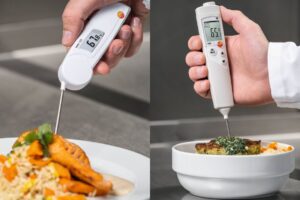
TESTO 103 Folding Penetration Thermometer
Features:
- Ultra-Compact & Portable
- Fast and accurate
- Durable & Splashproof
- Long-Lasting Battery
Pros:
- Ensure consistent food temperatures and comply with HACCP regulations for ultimate peace of mind.
- Quickly and easily verify food safety, streamlining your workflow and saving valuable time.
- Keep it in your pocket for instant temperature checks wherever you need them.
Best for: All-around kitchen use, especially for those who value speed and simplicity.
TESTO 104 food thermometer
Features:
- Waterproof Champion
- Folding Convenience
- Rock-Solid Accuracy
- Versatile Temperature Range
Pros:
- Quickly and accurately measure food temperatures, streamlining workflows and saving time.
- You can get hassle-free cleaning because it simply rinses under running water for effortless hygiene maintenance.
- Tackle various food types and applications with confidence. It ensures the enhanced versatility.
Best for: Professional chefs and serious home cooks who demand the best.
TESTO 104-IR Thermometer
Features:
- Dual Functionality
- Precise & Reliable
- Wide Temperature Range
- Robust & Waterproof
- Convenient & Portable
Pros:
- Perform quick, accurate temperature checks without slowing down your workflow.
- Ensure consistent temperatures and comply with HACCP regulations for complete peace of mind.
- Keep it in your pocket for instant checks wherever you need them.
Best for: Tech-savvy cooks who love smart kitchen gadgets.
TESTO 105 One Hand Thermometer
Features:
- One-Hand Mastery
- Interchangeable Tips
- Accurate & Reliable
- Rugged & Waterproof
- Smart Alerts
- Backlit Display
Pros:
- Boost efficiency by performing quick and accurate checks without slowing down your workflow.
- Simply rinse under running water for hassle-free hygiene maintenance.
- Adapt to different food applications with interchangeable tips.
Best for: Home cooks looking for a thermometer with interchangeable tips.
TESTO 106 food thermometer
Features:
- Blazing-Fast Measurements
- Ultra-Fine Probe
- Customizable Alerts
- HACCP & EN 13485 Compliant
- Durable & Waterproof
- Auto-Hold Function
Pros:
- Perform lightning-fast checks without slowing down your workflow.
- Adhere to HACCP and EN 13485 regulations with confidence.
- Benefit from auto-hold, clear alerts, and a durable design.
Best for: Busy and Multi-tasking cooks.
TESTO 108 Digital Food Thermometer
Features:
- Blazing-Fast Measurements
- Dual Probe Compatibility
- Waterproof & Rugged
- HACCP & EN 13485 Compliant
- Large, Easy-Read Display
- Intuitive Controls
Pros:
- Complete lightning-fast checks without slowing down your food prep.
- Benefit from waterproof design, easy cleaning, and precise readings.
- Adhere to industry standards and ensure food safety with peace of mind.
Best for: Cooks who work in a demanding environment.
TESTO 805 infrared thermometer
Features:
- Non-Contact Measurement
- Compact & Pocket-Sized
- 1:1 Optics
- Scan Mode
- Optional Top Safe Case
Pros:
- Enact quick, contactless measurements without slowing down your workflow.
- Enjoy pocket-sized portability and effortless operation.
- Apply in various industries, from food controls to building services.
Best for: Deep frying enthusiasts and those cooking large cuts of meat.
TESTO 826-T2 Infrared Thermometer
Features:
- Non-Destructive Measurements
- Blazing-Fast Readings
- Precise Results
- Customizable Alerts
- HACCP & EN 13485 Compliant
- Durable & Waterproof
- Convenient TopSafe Case
Pros:
- Perform rapid temperature checks without slowing down your operations.
- Adhere to HACCP and EN 13485 regulations with confidence.
- Benefit from a durable, waterproof design and included protective case.
Best for: Fine dining cooks who cannot poke through their food.
TESTO 831 infrared thermometer
Features:
- Ultra-Fast Measurements
- Precision from a Distance
- Customizable Alerts
- HACCP Certified
- Durable & Ergonomic
Pros:
- Perform rapid temperature checks without slowing down your workflow.
- Simplify compliance leads to adhering to HACCP regulations effortlessly.
Best for: Casual cooks and outdoor enthusiasts.
Testo 191-T1 HACCP Thermometer
Features:
- High-Precision Monitoring
- Robust Design
- IP68 Waterproof
- Efficient Battery Replacement
- Large Data Storage
- HACCP and EN 13485 Compliant
Pros:
- Streamlines the validation of food safety processes.
- Enhances quality control, ensuring products meet health standards.
Best for: Cooks who need a huge capacity and extended monitoring periods.
How to Use a Food Thermometer Correctly
As you learn more about these food thermometers, let’s move on to how to use them professionally. Follow these steps, and you’ll be on your way to perfectly cooked meals every time.
- Choose the right spot: Insert the thermometer into the centre of the meat or poultry; do not insert it into the bones, fat, or sinew.
- Wait for it: Allow at least thirty seconds for the thermometer to come to a standstill. This ranges from 1 to 15 seconds based on the model you have chosen to run on your computer.
- Know your numbers: Make sure that you are fully aware of healthy cooking temperatures for various foods. For example, chicken or any poultry product should be cooked to 165F/74C. Medium-rare steak is best eaten at 135F/57C.
- Clean between uses: Clean the thermometer with soap and water or sanitizing wipes after each measurement.
- Calibrate regularly: To establish the credibility of your thermometer, you should calibrate it by placing it in ice water and boiling water. Adjust if necessary.
A common mistake to avoid is not to let the probe touch the cooking surface or the pan –it will be a fake reading.
Conclusion
Food thermometers may not be glamorous like a shiny knife or a beautiful cutting board, but they are vital for many applications. A good thermometer is one of the chef’s best friends, right next to a sharp knife.In this journey, we have tried to penetrate the world of food thermometers, got acquainted with the types and main characteristics, and even named the best ten thumbnails. In summary, the best thermometer depends on the cooking style, the amount of money one is willing to spend, and the technology one wishes to incorporate into cooking. Whether you are boiling eggs, baking a pie, grilling a steak or roasting a turkey, there is a food thermometer designed to assist you in getting it right. So equip yourself with this new temperature-taking buddy and dominate those recipes. Happy cooking